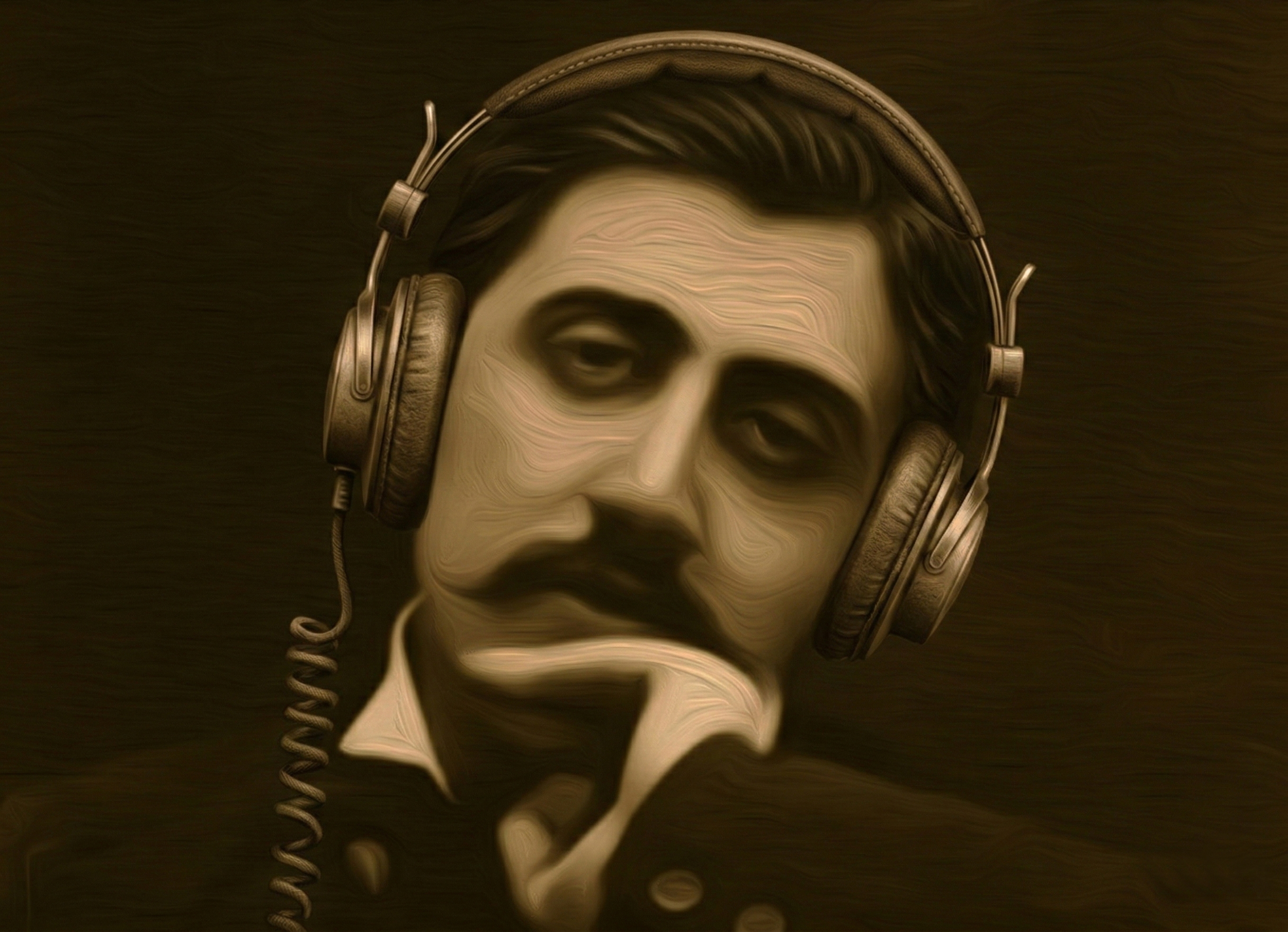
In Search of Lost Time (À la recherche du temps perdu) is a seven-volume novel by Marcel Proust (10 July 1871 – 18 November 1922), published between 1913 and 1927. The novel runs to roughly 1.25 million words, making it one of the longest ever published. As audio in the Scott Moncrieff translation, the complete work runs to an estimated 170 to 180 hours. Proust FM broadcasts it free, in full, with the text to read along.
Marcel Proust was a French novelist, critic and essayist of the Belle Époque, born in Auteuil, Paris. Proust is known chiefly for a single work, written across the last 14 years of his life and published in part after his death. The novel is concerned with involuntary memory, social observation, jealousy, art, and the experience of time as it is lived rather than measured.
This reference page lists the volumes in order, how long each takes to listen to, the concepts that recur, and how the English translations differ. Every volume listed links to the audio, which is free and requires no account or sign-in.
The seven volumes in order
| # | French title | English title | Published | Listening time |
|---|---|---|---|---|
| 1 | Du côté de chez Swann | Swann's Way | 1913 | 21 hr 54 min |
| 2 | À l'ombre des jeunes filles en fleurs | Within a Budding Grove In the Shadow of Young Girls in Flower |
1919 | 26 hr 23 min |
| 3 | Le Côté de Guermantes | The Guermantes Way | 1920–21 | 28 hr 44 min |
| 4 | Sodome et Gomorrhe | Cities of the Plain Sodom and Gomorrah |
1921–22 | In progress |
| 5 | La Prisonnière | The Captive The Prisoner |
1923 | Not yet recorded |
| 6 | Albertine disparue | The Sweet Cheat Gone The Fugitive |
1925 | Not yet recorded |
| 7 | Le Temps retrouvé | Time Regained Finding Time Again |
1927 | Not yet recorded |
English titles given first are C. K. Scott Moncrieff's, which are the ones used on this site. Titles beneath are the more common modern renderings. The final three volumes were published after Proust's death in 1922, edited from manuscripts he had not finished revising.
What happens in each volume
- Swann's Way
- Swann's Way establishes the childhood world of Combray, the Narrator's desperate need for his mother's goodnight kiss, and the madeleine episode that gives rise to the novel's central theme of involuntary memory. The second half steps back in time to recount Charles Swann's obsessive love for the courtesan Odette de Crécy. Key figures: the Narrator, Swann, Odette, Gilberte, Aunt Léonie, Françoise.
- Within a Budding Grove
- Within a Budding Grove moves between Paris and the coastal resort of Balbec, tracing adolescence and first infatuation. The volume introduces Albertine Simonet, the Narrator's great love, and Robert de Saint-Loup, his closest friend, and develops the painter Elstir, whose work shapes the Narrator's aesthetic sense. The volume won the Prix Goncourt in 1919.
- The Guermantes Way
- The Guermantes Way follows the Narrator's entry into Parisian aristocratic society and his infatuation with the Duchesse de Guermantes. The Dreyfus Affair divides the salons and exposes anti-Semitism and political hypocrisy. Running against this is the illness and death of the Narrator's grandmother, the novel's most direct treatment of grief. Key figures: the Duchesse de Guermantes, the Baron de Charlus.
- Cities of the Plain
- Cities of the Plain opens with the Narrator's discovery of the Baron de Charlus's relationship with the tailor Jupien, and turns to homosexuality, social masking and decay. The Narrator's suspicions about Albertine begin here. Key figures: Charlus, Jupien, Albertine, the violinist Morel.
- The Captive
- The Captive confines the Narrator and Albertine to a Paris apartment, in a study of jealousy as a form of imprisonment for both parties. Vinteuil's music becomes the volume's central symbol of what art can hold that life cannot.
- The Sweet Cheat Gone
- The Sweet Cheat Gone follows Albertine's flight, and the strange, uneven process of forgetting and the defying of habit that follows. The Narrator travels to Venice with his mother. Gilberte Swann returns to the narrative.
- Time Regained
- Time Regained shows Paris during the First World War and, at a last ball, a society grown old almost beyond recognition. A series of accidental sensations convinces the Narrator that art is the only means of recovering lost time, and that the novel he must write is the one the reader has just finished.
Key concepts
- Involuntary memory (mémoire involontaire)
- Involuntary memory is memory triggered unexpectedly by a physical sensation – a taste, a smell, a texture – which revives the emotional past whole rather than as information. Marcel Proust contrasts it with voluntary memory, the deliberate act of recollection, which he argues returns only stripped-down intellectual facts with the feeling gone out of them. The distinction is the engine of the entire novel.
- The madeleine episode
- The madeleine episode occurs in the Overture of Swann's Way. The narrator dips a small shell-shaped cake into lime-blossom tea and is returned bodily to the Combray of his childhood. The passage is the most quoted in the novel and the standard illustration of involuntary memory. In the audio it falls near the end of the Overture, roughly two hours in.
- The two ways: Swann's and Guermantes
- The two ways are the walking routes taken from the family house at Combray: one past Charles Swann's property, one toward the Guermantes estate. The two ways stand for opposed social worlds, bourgeois and aristocratic, and for opposed ideas of life. That the two are finally revealed to join is one of the novel's structural jokes and one of its deepest revelations.
- The final epiphanies
- In Time Regained, a stumble on uneven paving stones, the sound of a spoon against a plate, and the stiffness of a napkin each produce the same involuntary return of the past into the mind of the Narrator. These sensations convince the him that art alone can hold experience against time, decay and death, and that he must write.
- The Narrator
- The Narrator of In Search of Lost Time is unnamed for almost the entire novel, and is addressed as 'Marcel' only twice and equivocally. The novel draws on Proust's life but is not autobiographical, and Proust argued explicitly, in opposition to critics like Sainte-Beuve, that the self that writes is not the self that lives.
Which English translation
| Edition | Translators | Character | Best for |
|---|---|---|---|
| Chatto & Windus | C. K. Scott Moncrieff and Terence Kilmartin, with Andreas Mayor on the final volume. | Flowing, ornate, Edwardian | Readers who want the classic English rhythm |
| Modern Library | C. K. Scott Moncrieff and Terence Kilmartin, with Andreas Mayor on the final volume; revised by D. J. Enright | Still flowing, still ornate, but slightly more digestible | Readers who want something closer to modern-day English |
| Penguin Classics | A different translator per volume under the general editorship of Christopher Prendergast: Lydia Davis, James Grieve, Mark Treharne, John Sturrock, Carol Clark, Peter Collier, Ian Patterson | Sharper, closer to the French, varied voice | Readers who want fidelity over cadence |
| NYRB Classics | James Grieve (volumes 1–2 only) | Colloquial, direct, quick | Readers who find Edwardian syntax hard going |
| Oxford World's Classics in progress |
A different translator per volume, co-edited by Brian Nelson and Adam Watt: Brian Nelson, Charlotte Mandell, Peter Bush | Contemporary, scholarly, freshly retitled | Readers who want the newest scholarship and full notes |
Proust FM uses the original C. K. Scott Moncrieff translation, published between 1922 and 1930 and now in the public domain. That is the practical reason: it can be given away. It is also the version most English readers mean when they talk about reading Proust, and its cadences are part of how the novel sounds in English.
Moncrieff has faults. Moncrieff worked from an imperfect French text, softened Proust in places, and gave the novel the borrowed Shakespearean title Remembrance of Things Past, which Proust would not have chosen. Later translators have corrected much of this. But no other complete translation is free.
One point of detail: C. K. Scott Moncrieff died in 1930, having translated the first six volumes. Moncrieff never translated Le Temps retrouvé. The final volume reached English readers through other hands, firstly Stephen Hudson (a pseudonym of Sydney Schiff) and later, Andreas Mayor.
How long it takes to listen
Proust FM currently broadcasts the first three complete volumes which run to 77 hr 1 min, averaging 25 hr 40 min each. On that basis the complete seven-volume novel should come to somewhere between 170 and 180 hours when finished.
By comparison, reading the novel at a typical 250 words per minute would take roughly 83 hours. Proust's sentences resist skimming, and much of the apparent difficulty of the novel dissolves when the sentences are heard at a steady pace rather than scanned over by the restless eye.
Common questions
- Do you have to read the volumes in order?
- Yes, for the most part. The novel is continuous, and characters introduced in a single line early on become central hundreds of pages later. Swann's Way stands alone reasonably well, and the 'Swann in Love' section inside it works almost as a novella, but everything after volume one assumes what came before.
- Where should I start?
- Start with the Overture, the first section of Swann's Way. It runs 2 hr 17 min and contains the madeleine sequence. It is also a fair test: if the Overture holds you, the remaining hours will.
- Why did Proust write in a cork-lined bedroom?
- Marcel Proust lined his bedroom at 102 Boulevard Haussmann with cork to deaden street noise. Proust suffered from severe asthma and an acute sensitivity to sound and smell, and worked at night, sleeping through much of the day.
- What is the Proust Questionnaire?
- The Proust Questionnaire is a set of personality questions from a Victorian confession album, of the kind popular in French parlours in the 1880s. Marcel Proust did not invent the questionnaire; Proust answered it twice as a young man, and his answers were sufficiently memorable that the form now carries his name.
- Is Proust FM free?
- Yes. The audio and the text are free, with no account and no payment. The Scott Moncrieff translation is in the public domain. The project is run at cost by one person.