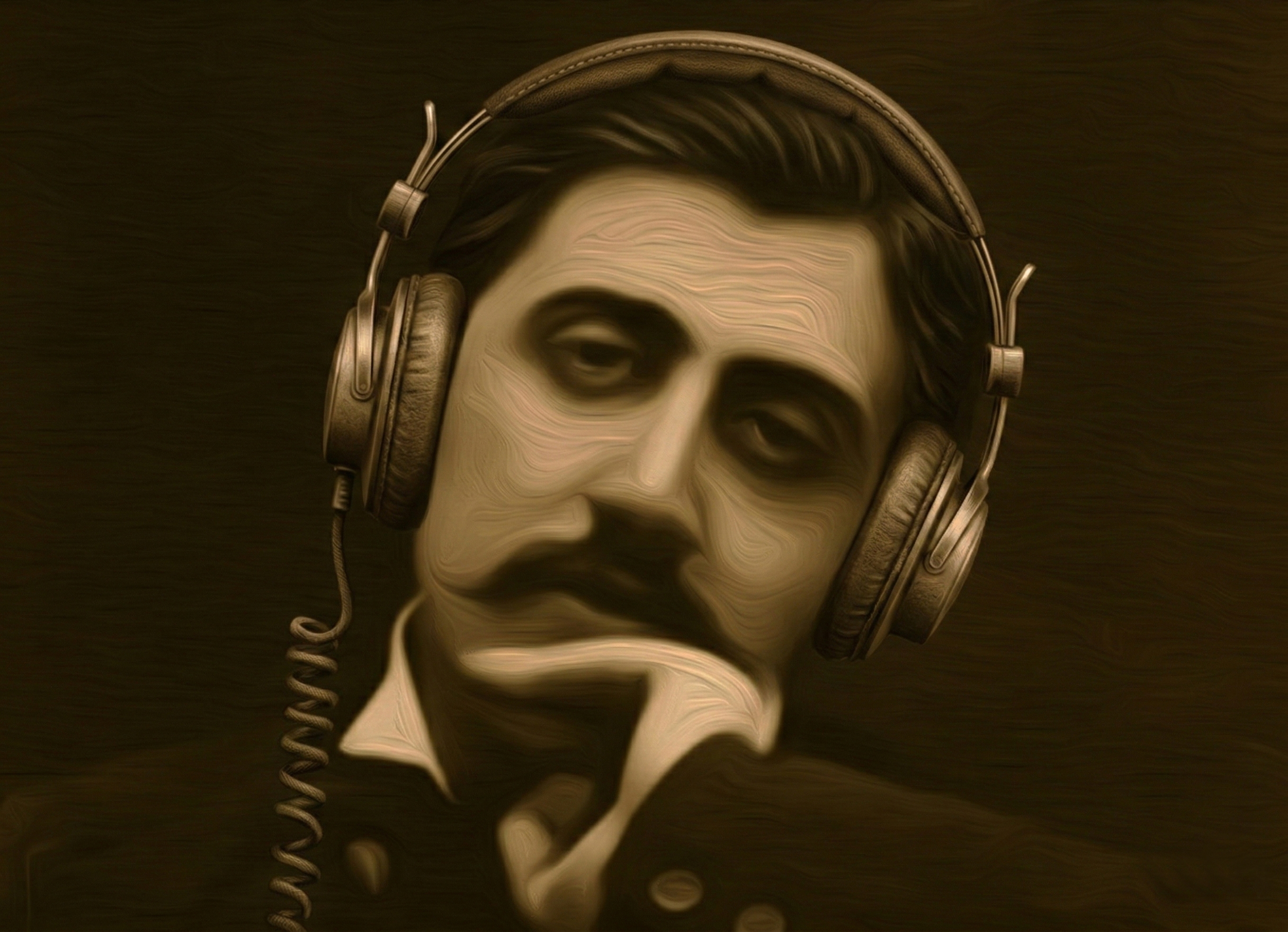
All the same I could see that, during the hour that followed, he was more than once on the point of telephoning to his mistress to beg for a reconciliation. My father had now had the telephone for some time at home, but I doubt whether that would have been of much use to Saint-Loup. Besides, it hardly seemed to me quite proper to make my parents, or even a mechanical instrument installed in their house, play pander between Saint-Loup and his mistress, ladylike and high-minded as the latter might be. His bad dream began to fade from his memory. With a fixed and absent stare, he came to see me on each of those cruel days which traced in my mind as they followed one after the other the splendid sweep of a staircase forged in hard metal on which Robert stood asking himself what decision his friend was going to take.
At length she wrote to ask whether he would consent to forgive her. As soon as he realised that a definite rupture had been avoided he saw all the disadvantages of a reconciliation. Besides, he had already begun to suffer less acutely, and had almost accepted a grief the sharp tooth of which he would have, in a few months perhaps, to feel again if their intimacy were to be resumed. He did not hesitate for long. And perhaps he hesitated only because he was now certain of being able to recapture his mistress, of being able to do it and therefore of doing it. Only she asked him, so that she might have time to recover her equanimity, not to come to Paris at the New Year. Now he had not the heart to go to Paris without seeing her. On the other hand, she had declared her willingness to go abroad with him, but for that he would need to make a formal application for leave, which Captain de Borodino was unwilling to grant.
“I’m sorry about it, because of your meeting with my aunt, which will have to be put off. I dare say I shall be in Paris at Easter.”
“We shan’t be able to call on Mme. de Guermantes then, because I shall have gone to Balbec. But, really, it doesn’t matter in the least, I assure you.”
“To Balbec? But you didn’t go there till August.”
“I know; but next year they’re making me go there earlier, for my health.”
All that he feared was that I might form a bad impression of his mistress, after what he had told me. “She is violent simply because she is too frank, too thorough in her feelings. But she is a sublime creature. You can’t imagine what exquisite poetry there is in her. She goes every year to spend All Souls’ Day at Bruges. ‘Nice’ of her, don’t you think? If you ever do meet her you’ll see what I mean; she has a greatness. …” And, as he was infected with certain of the mannerisms used in the literary circles in which the lady moved: “There is something sidereal about her, in fact something bardic; you know what I mean, the poet merging into the priest.”
I was searching all through dinner for a pretext which would enable Saint-Loup to ask his aunt to see me without my having to wait until he came to Paris. Now such a pretext was furnished by the desire that I had to see some more pictures by Elstir, the famous painter whom Saint-Loup and I had met at Balbec. A pretext behind which there was, moreover, an element of truth, for if, on my visits to Elstir, what I had asked of his painting had been that it should lead me to the comprehension and love of things better than itself, a real thaw, an authentic square in a country town, live women on a beach (all the more would I have commissioned from it the portraits of the realities which I had not been able to fathom, such as a lane of hawthorn-blossoms, not so much that it might perpetuate their beauty for me as that it might reveal that beauty to me), now, on the other hand, it was the originality, the seductive attraction of those paintings that aroused my desire, and what I wanted above anything else was to look at other pictures by Elstir.
It seemed to me, also, that the least of his pictures were something quite different from the masterpieces even of greater painters than himself. His work was like a realm apart, whose frontiers were not to be passed, matchless in substance. Eagerly collecting the infrequent periodicals in which articles on him and his work had appeared, I had learned that it was only recently that he had begun to paint landscapes and still life, and that he had started with mythological subjects (I had seen photographs of two of these in his studio), and had then been for long under the influence of Japanese art.
Several of the works most characteristic of his various manners were scattered about the provinces. A certain house at Les Andelys, in which there was one of his finest landscapes, seemed to me as precious, gave me as keen a desire to go there and see it as did a village in the Chartres district, among whose millstone walls was enshrined a glorious painted window; and towards the possessor of this treasure, towards the man who, inside his ugly house, on the main street, closeted like an astrologer, sat questioning one of those mirrors of the world which Elstir’s pictures were, and who had perhaps bought it for many thousands of francs, I felt myself borne by that instinctive sympathy which joins the very hearts, the inmost natures of those who think alike upon a vital subject. Now three important works by my favourite painter were described in one of these articles as belonging to Mme. de Guermantes. So that it was, after all, quite sincerely that, on the evening on which Saint-Loup told me of his lady’s projected visit to Bruges, I was able, during dinner, in front of his friends, to let fall, as though on the spur of the moment:
“Listen, if you don’t mind. Just one last word on the subject of the lady we were speaking about. You remember Elstir, the painter I met at Balbec?”
“Why, of course I do.”
“You remember how much I admired his work?”
“I do, quite well; and the letter we sent him.”
“Very well, one of the reasons—not one of the chief reasons, a subordinate reason—why I should like to meet the said lady—you do know who I mean, don’t you?”
“Of course I do. How involved you’re getting.”
“Is that she has in her house one very fine picture, at least, by Elstir.”
“I say, I never knew that.”
“Elstir will probably be at Balbec at Easter; you know he stays down there now all the year round, practically. I should very much like to have seen this picture before I leave Paris. I don’t know whether you’re on sufficiently intimate terms with your aunt: but couldn’t you manage, somehow, to give her so good an impression of me that she won’t refuse, and then ask her if she’ll let me come and see the picture without you, since you won’t be there?”
“That’s all right. I’ll answer for her; I’ll make a special point of it.”
“Oh, Robert, you are an angel; I do love you.”
“It’s very nice of you to love me, but it would be equally nice if you were to call me tu, as you promised, and as you began to do.”
“I hope it’s not your departure that you two are plotting together,” one of Robert’s friends said to me. “You know, if Saint-Loup does go on leave, it needn’t make any difference, we shall still be here. It will be less amusing for you, perhaps, but we’ll do all we can to make you forget his absence.” As a matter of fact, just as we had decided that Robert’s mistress would have to go to Bruges by herself, the news came that Captain de Borodino, obdurate hitherto in his refusal, had given authority for Serjeant Saint-Loup to proceed on long leave to Bruges. What had happened was this. The Prince, extremely proud of his luxuriant head of hair, was an assiduous customer of the principal hairdresser in the town, who had started life as a boy under Napoleon III’s barber. Captain de Borodino was on the best of terms with the hairdresser, being, in spite of his air of majesty, quite simple in his dealings with his inferiors. But the hairdresser, through whose books the Prince’s account had been running without payment for at least five years, swollen no less by bottles of Portugal and Eau des Souverains, irons, razors, and strops, than by the ordinary charges for shampooing, haircutting and the like, had a greater respect for Saint-Loup, who always paid on the nail and kept several carriages and saddle-horses. Having learned of Saint-Loup’s vexation at not being able to go with his mistress, he had spoken strongly about it to the Prince at a moment when he was trussed up in a white surplice with his head held firmly over the back of the chair and his throat menaced by a razor. This narrative of a young man’s gallant adventures won from the princely captain a smile of Bonapartish indulgence. It is hardly probable that he thought of his unpaid bill, but the barber’s recommendation tended to put him in as good a humour as one from a duke would have put him in a bad. While his chin was still smothered in soap, the leave was promised, and the warrant was signed that evening. As for the hairdresser, who was in the habit of boasting all day long of his own exploits, and in order to do so claimed for himself, showing an astonishing faculty for lying, distinctions that were pure fabrications, having for once rendered this signal service to Saint-Loup, not only did he refrain from publishing it broadcast, but, as if vanity were obliged to lie, and when there was no scope for lying gave place to modesty, he never mentioned the matter to Robert again.
All his friends assured me that, as long as I stayed at Doncières, or if I should come there again at any time, even although Robert were away, their horses, their quarters, their time would be at my disposal, and I felt that it was with the greatest cordiality that these young men put their comfort and youth and strength at the service of my weakness.
“Why on earth,” they went on, after insisting that I should stay, “don’t you come down here every year; you see how our quiet life appeals to you! Besides you’re so keen about everything that goes on in the Regiment; quite the old soldier.”
For I continued my eager demands that they would classify the different officers whose names I knew according to the degree of admiration which they seemed to deserve, just as, in my schooldays, I used to make the other boys classify the actors of the Théâtre-Français. If, in the place of one of the generals whom I had always heard mentioned at the head of the list, such as Galliffet or Négrier, one of Saint-Loup’s friends, with a contemptuous: “But Négrier is one of the feeblest of our general officers,” put the new, intact, appetising name of Pau or Geslin de Bourgogne, I felt the same joyful surprise as long ago when the outworn name of Thiron or Febvre was sent flying by the sudden explosion of the unfamiliar name of Amaury. “Better even than Négrier? But in what respect; give me an example?” I should have liked there to exist profound differences even among the junior officers of the regiment, and I hoped in the reason for these differences to seize the essential quality of what constituted military superiority. The one whom I should have been most interested to hear discussed, because he was the one whom I had most often seen, was the Prince de Borodino. But neither Saint-Loup nor his friends, if they did justice to the fine officer who kept his squadron up to the supreme pitch of efficiency, liked the man. Without speaking of him, naturally, in the same tone as of certain other officers, rankers and freemasons, who did not associate much with the rest and had, in comparison, an uncouth, barrack-room manner, they seemed not to include M. de Borodino among the officers of noble birth, from whom, it must be admitted, he differed considerably in his attitude even towards Saint-Loup. The others, taking advantage of the fact that Robert was only an N.C.O., and that therefore his influential relatives might be grateful were he invited to the houses of superior officers on whom ordinarily they would have looked down, lost no opportunity of having him to dine when any bigwig was expected who might be of use to a young cavalry serjeant. Captain de Borodino alone confined himself to his official relations (which, for that matter, were always excellent) with Robert. The fact was that the Prince, whose grandfather had been made a Marshal and a Prince-Duke by the Emperor, with whose family he had subsequently allied himself by marriage, while his father had married a cousin of Napoleon III and had twice been a Minister after the Coup d’Etat, felt that in spite of all this he did not count for much with Saint-Loup and the Guermantes connection, who in turn, since he did not look at things from the same point of view as they, counted for very little with him. He suspected that, for Saint-Loup, he himself was—he, a kinsman of the Hohenzollern—not a true noble but the grandson of a farmer, but at the same time he regarded Saint-Loup as the son of a man whose Countship had been confirmed by the Emperor—one of what were known in the Faubourg Saint-Germain as “touched-up” Counts—and who had besought him first for a Prefecture, then for some other post a long way down the list of subordinates to His Highness the Prince de Borodino, Minister of State, who was styled on his letters “Monseigneur” and was a nephew of the Sovereign.
Something more than a nephew, possibly. The first Princesse de Borodino was reputed to have bestowed her favours on Napoleon I, whom she followed to the Isle of Elba, and the second hers on Napoleon III. And if, in the Captain’s placid countenance, one caught a trace of Napoleon I—if not in his natural features, at least in the studied majesty of the mask—the officer had, particularly in his melancholy and kindly gaze, in his drooping moustache, something that reminded one also of Napoleon III; and this in so striking a fashion that, having asked leave, after Sedan, to join the Emperor in captivity, and having been sent away by Bismarck, before whom he had been brought, the latter, happening to look up at the young man who was preparing to leave the room, was at once impressed by the likeness and, reconsidering his decision, recalled him and gave him the authorisation which he, in common with everyone else, had just been refused.
If the Prince de Borodino was not prepared to make overtures to Saint-Loup nor to the other representatives of Faubourg Saint-Germain society that there were in the regiment (while he frequently invited two subalterns of plebeian origin who were pleasant companions) it was because, looking down upon them all from the height of his Imperial grandeur, he drew between these two classes of inferiors the distinction that one set consisted of inferiors who knew themselves to be such and with whom he was delighted to spend his time, being beneath his outward majesty of a simple, jovial humour, and the other of inferiors who thought themselves his superiors, a claim which he could not allow. And so, while all the other officers of the regiment made much of Saint-Loup, the Prince de Borodino, to whose care the young man had been recommended by Marshal X⸺, confined himself to being obliging with regard to the military duties which Saint-Loup always performed in the most exemplary fashion, but never had him to his house except on one special occasion when he found himself practically compelled to invite him, and when, as this occurred during my stay at Doncières, he asked him to bring me to dinner also. I had no difficulty that evening, as I watched Saint-Loup sitting at his Captain’s table, in distinguishing, in their respective manners and refinements, the difference that existed between the two aristocracies: the old nobility and that of the Empire. The offspring of a caste the faults of which, even if he repudiated them with all the force of his intellect, had been absorbed into his blood, a caste which, having ceased to exert any real authority for at least a century, saw nothing more now in the protective affability which formed part of its regular course of education, than an exercise, like horsemanship or fencing, cultivated without any serious purpose, as a sport; on meeting representatives of that middle class on which the old nobility so far looked down as to believe that they were flattered by its intimacy and would be honoured by the informality of its tone, Saint-Loup would take the hand of no matter who might be introduced to him, though he had failed perhaps to catch the stranger’s name, in a friendly grip, and as he talked to him (crossing and uncrossing his legs all the time, flinging himself back in his chair in an attitude of absolute unconstraint, one foot in the palm of his hand) call him “my dear fellow.” Belonging on the other hand to a nobility whose titles still preserved their original meaning, provided that their holders still possessed the splendid emoluments given in reward for glorious services and bringing to mind the record of high offices in which one is in command of numberless men and must know how to deal with men, the Prince de Borodino—not perhaps very distinctly or with any clear personal sense of superiority, but at any rate in his body, which revealed it by its attitudes and behaviour generally—regarded his own rank as a prerogative that was still effective; those same commoners whom Saint-Loup would have slapped on the shoulder and taken by the arm he addressed with a majestic affability, in which a reserve instinct with grandeur tempered the smiling good-fellowship that came naturally to him, in a tone marked at once by a genuine kindliness and a stiffness deliberately assumed. This was due, no doubt, to his being not so far removed from the great Embassies, and the Court itself, at which his father had held the highest posts, whereas the manners of Saint-Loup, the elbow on the table, the foot in the hand, would not have been well received there; but principally it was due to the fact that he looked down less upon the middle classes because they were the inexhaustible source from which the first Emperor had chosen his Marshals and his nobles and in which the second had found a Rouher and a Fould.
Son, doubtless, or grandson of an Emperor, who had nothing more important to do than to command a squadron, the preoccupations of his putative father and grandfather could not, for want of an object on which to fasten themselves, survive in any real sense in the mind of M. de Borodino. But as the spirit of an artist continues to model, for many years after he is dead, the statue which he carved, so they had taken shape in him, were materialised, incarnate in him, it was they that his face reflected. It was with, in his voice, the vivacity of the first Emperor that he worded a reprimand to a corporal, with the dreamy melancholy of the second that he puffed out the smoke of a cigarette. When he passed in plain clothes through the streets of Doncières, a certain sparkle in his eyes escaping from under the brim of the bowler hat sent radiating round this captain of cavalry a regal incognito; people trembled when he strode into the serjeant-major’s office, followed by the adjutant and the quartermaster, as though by Berthier and Masséna. When he chose the cloth for his squadron’s breeches, he fastened on the master-tailor a gaze capable of baffling Talleyrand and deceiving Alexander; and at times, in the middle of an inspection, he would stop, let his handsome blue eyes cloud with dreams, twist his moustache, with the air of one building up a new Prussia and a new Italy. But a moment later, reverting from Napoleon III to Napoleon I, he would point out that the equipment was not properly polished, and would insist on tasting the men’s rations. And at home, in his private life, it was for the wives of middle class officers (provided that their husbands were not freemasons) that he would bring out not only a dinner service of royal blue Sèvres, fit for an Ambassador (which had been given to his father by Napoleon, and appeared even more priceless in the commonplace house on a provincial street in which he was living, like those rare porcelains which tourists admire with a special delight in the rustic china-cupboard of some old manor that has been converted into a comfortable and prosperous farm house), but other gifts of the Emperor also: those noble and charming manners, which too would have won admiration in some diplomatic post abroad, if, for some men, it did not mean a lifelong condemnation to the most unjust form of ostracism, merely to be well born; his easy gestures, his kindness, his grace, and, embedding beneath an enamel that was of royal blue, also glorious images, the mysterious, illuminated, living reliquary of his gaze. And, in treating of the social relations with the middle classes which the Prince had at Doncières, it may be as well to add these few words. The lieutenant-colonel played the piano beautifully; the senior medical officer’s wife sang like a Conservatoire medallist. This latter couple, as well as the lieutenant-colonel and his wife, used to dine every week with M. de Borodino. They were flattered, unquestionably, knowing that when the Prince went to Paris on leave he dined with Mme. de Pourtalès, and the Murats, and people like that. “But,” they said to themselves, “he’s just a captain, after all; he’s only too glad to get us to come. Still, he’s a real friend, you know.” But when M. de Borodino, who had long been pulling every possible wire to secure an appointment for himself nearer Paris, was posted to Beauvais, he packed up and went, and forgot as completely the two musical couples as he forgot the Doncières theatre and the little restaurant to which he used often to send out for his luncheon, and, to their great indignation, neither the lieutenant-colonel nor the senior medical officer, who had so often sat at his table, ever had so much as a single word from him for the rest of their lives.
One morning, Saint-Loup confessed to me that he had written to my grandmother to give her news of me, with the suggestion that, since there was telephonic connection between Paris and Doncières, she might make use of it to speak to me. In short, that very day she was to give me a call, and he advised me to be at the post office at about a quarter to four. The telephone was not yet at that date as commonly in use as it is today. And yet habit requires so short a time to divest of their mystery the sacred forces with which we are in contact, that, not having had my call at once, the only thought in my mind was that it was very slow, and badly managed, and I almost decided to lodge a complaint. Like all of us nowadays I found not rapid enough for my liking in its abrupt changes the admirable sorcery for which a few moments are enough to bring before us, invisible but present, the person to whom we have been wishing to speak, and who, while still sitting at his table, in the town in which he lives (in my grandmother’s case, Paris), under another sky than ours, in weather that is not necessarily the same, in the midst of circumstances and worries of which we know nothing, but of which he is going to inform us, finds himself suddenly transported hundreds of miles (he and all the surroundings in which he remains immured) within reach of our ear, at the precise moment which our fancy has ordained. And we are like the person in the fairytale to whom a sorceress, on his uttering the wish, makes appear with supernatural clearness his grandmother or his betrothed in the act of turning over a book, of shedding tears, of gathering flowers, quite close to the spectator and yet ever so remote, in the place in which she actually is at the moment. We need only, so that the miracle may be accomplished, apply our lips to the magic orifice and invoke—occasionally for rather longer than seems to us necessary, I admit—the Vigilant Virgins to whose voices we listen every day without ever coming to know their faces, and who are our Guardian Angels in the dizzy realm of darkness whose portals they so jealously keep; the All Powerful by whose intervention the absent rise up at our side, without our being permitted to set eyes on them; the Danaids of the Unseen who without ceasing empty, fill, transmit the urns of sound; the ironic Furies who, just as we were murmuring a confidence to a friend, in the hope that no one was listening, cry brutally: “I hear you!”; the ever infuriated servants of the Mystery, the umbrageous priestesses of the Invisible, the Young Ladies of the Telephone.
And, the moment our call has sounded, in the night filled with phantoms to which our ears alone are unsealed, a tiny sound, an abstract sound—the sound of distance overcome—and the voice of the dear one speaks to us.
It is she, it is her voice that is speaking, that is there. But how remote it is! How often have I been unable to listen without anguish, as though, confronted by the impossibility of seeing, except after long hours of journeying, her whose voice has been so close to my ear, I felt more clearly the sham and illusion of meetings apparently most pleasant, and at what a distance we may be from the people we love at the moment when it seems that we have only to stretch out our hand to seize and hold them. A real presence indeed that voice so near—in actual separation. But a premonition also of an eternal separation! Over and again, as I listened in this way, without seeing her who spoke to me from so far away, it has seemed to me that the voice was crying to me from depths out of which one does not rise again, and I have known the anxiety that was one day to wring my heart when a voice should thus return (alone, and attached no longer to a body which I was never more to see), to murmur, in my ear, words I would fain have kissed as they issued from lips forever turned to dust.
This afternoon, alas, at Doncières, the miracle did not occur. When I reached the post office, my grandmother’s call had already been received; I stepped into the box; the line was engaged; someone was talking who probably did not realise that there was nobody to answer him, for when I raised the receiver to my ear, the lifeless block began squeaking like Punchinello; I silenced it, as one silences a puppet, by putting it back on its hook, but, like Punchinello, as soon as I took it again in my hand, it resumed its gabbling. At length, giving it up as hopeless, by hanging up the receiver once and for all, I stifled the convulsions of this vociferous stump which kept up its chatter until the last moment, and went in search of the operator, who told me to wait a little; then I spoke, and, after a few seconds of silence, suddenly I heard that voice which I supposed myself, mistakenly, to know so well; for always until then, every time that my grandmother had talked to me, I had been accustomed to follow what she was saying on the open score of her face, in which the eyes figured so largely; but her voice itself I was hearing this afternoon for the first time. And because that voice appeared to me to have altered in its proportions from the moment that it was a whole, and reached me in this way alone and without the accompaniment of her face and features, I discovered for the first time how sweet that voice was; perhaps, too, it had never been so sweet, for my grandmother, knowing me to be alone and unhappy, felt that she might let herself go in the outpouring of an affection which, on her principle of education, she usually restrained and kept hidden. It was sweet, but also how sad it was, first of all on account of its very sweetness, a sweetness drained almost—more than any but a few human voices can ever have been—of every element of resistance to others, of all selfishness; fragile by reason of its delicacy it seemed at every moment ready to break, to expire in a pure flow of tears; then, too, having it alone beside me, seen, without the mask of her face, I noticed for the first time the sorrows that had scarred it in the course of a lifetime.
Was it, however, solely the voice that, because it was alone, gave me this new impression which tore my heart? Not at all; it was rather that this isolation of the voice was like a symbol, a presentation, a direct consequence of another isolation, that of my grandmother, separated, for the first time in my life, from myself. The orders or prohibitions which she addressed to me at every moment in the ordinary course of my life, the tedium of obedience or the fire of rebellion which neutralised the affection that I felt for her were at this moment eliminated, and indeed might be eliminated forever (since my grandmother no longer insisted on having me with her under her control, was in the act of expressing her hope that I would stay at Doncières altogether, or would at any rate extend my visit for as long as possible, seeing that both my health and my work seemed likely to benefit by the change); also, what I held compressed in this little bell that was ringing in my ear was, freed from the conflicting pressures which had, every day hitherto, given it a counterpoise, and from this moment irresistible, carrying me altogether away, our mutual affection. My grandmother, by telling me to stay, filled me with an anxious, an insensate longing to return. This freedom of action which for the future she allowed me and to which I had never dreamed that she would consent, appeared to me suddenly as sad as might be my freedom of action after her death (when I should still love her and she would forever have abandoned me). “Granny!” I cried to her, “Granny!” and would fain have kissed her, but I had beside me only that voice, a phantom, as impalpable as that which would come perhaps to revisit me when my grandmother was dead. “Speak to me!” but then it happened that, left more solitary still, I ceased to catch the sound of her voice. My grandmother could no longer hear me; she was no longer in communication with me; we had ceased to stand face to face, to be audible to one another; I continued to call her, sounding the empty night, in which I felt that her appeals also must be straying. I was shaken by the same anguish which, in the distant past, I had felt once before, one day when, a little child, in a crowd, I had lost her, an anguish due less to my not finding her than to the thought that she must be searching for me, must be saying to herself that I was searching for her; an anguish comparable to that which I was to feel on the day when we speak to those who can no longer reply and whom we would so love to have hear all the things that we have not told them, and our assurance that we are not unhappy. It seemed as though it were already a beloved ghost that I had allowed to lose herself in the ghostly world, and, standing alone before the instrument, I went on vainly repeating: “Granny! Granny!” as Orpheus, left alone, repeats the name of his dead wife. I decided to leave the post office, to go and find Robert at his restaurant, in order to tell him that, as I was half expecting a telegram which would oblige me to return to Paris, I wished at all costs to find out at what times the trains left. And yet, before reaching this decision, I felt I must make one attempt more to invoke the Daughters of the Night, the Messengers of the Word, the Deities without form or feature; but the capricious Guardians had not deigned once again to unclose the miraculous portals, or more probably, had not been able; in vain might they untiringly appeal, as was their custom, to the venerable inventor of printing and the young prince, collector of impressionist paintings and driver of motorcars (who was Captain de Borodino’s nephew); Gutenberg and Wagram left their supplications unanswered, and I came away, feeling that the Invisible would continue to turn a deaf ear.
When I came among Robert and his friends, I withheld the confession that my heart was no longer with them, that my departure was now irrevocably fixed. Saint-Loup appeared to believe me, but I learned afterwards that he had from the first moment realised that my uncertainty was feigned and that he would not see me again next day. And while, letting their plates grow cold, his friends joined him in searching through the timetable for a train which would take me to Paris, and while we heard in the cold, starry night the whistling of the engines on the line, I certainly felt no longer the same peace of mind which on all these last evenings I had derived from the friendship of the former and the latter’s distant passage. And yet they did not fail me this evening, performing the same office in a different way. My departure overpowered me less when I was no longer obliged to think of it by myself, when I felt that there was concentrated on what was to be done the more normal, more wholesome activity of my strenuous friends, Robert’s brothers in arms, and of those other strong creatures, the trains, whose going and coming, night and morning, between Doncières and Paris, broke up in retrospect what had been too compact and insupportable in my long isolation from my grandmother into daily possibilities of return.
“I don’t doubt the truth of what you’re saying, or that you aren’t thinking of leaving us just yet,” said Saint-Loup, smiling; “but pretend you are going, and come and say goodbye to me tomorrow morning; early, otherwise there’s a risk of my not seeing you; I’m going out to luncheon, I’ve got leave from the Captain; I shall have to be back in barracks by two, as we are to be on the march all afternoon. I suppose the man to whose house I’m going, a couple of miles out, will manage to get me back in time.”
Scarcely had he uttered these words when a messenger came for me from my hotel; the telephone operator had sent to find me. I ran to the post office, for it was nearly closing time. The word “trunks” recurred incessantly in the answers given me by the officials. I was in a fever of anxiety, for it was my grandmother who had asked for me. The office was closing for the night. Finally I got my connection. “Is that you, Granny?” A woman’s voice, with a strong English accent, answered: “Yes, but I don’t know your voice.” Neither did I recognise the voice that was speaking to me; besides, my grandmother called me tu, and not vous. And then all was explained. The young man for whom his grandmother had called on the telephone had a name almost identical with my own, and was staying in an annex of my hotel. This call coming on the very day on which I had been telephoning to my grandmother, I had never for a moment doubted that it was she who was asking for me. Whereas it was by pure coincidence that the post office and the hotel had combined to make a twofold error.
The following morning I rose late, and failed to catch Saint-Loup, who had already started for the country house where he was invited to luncheon. About half past one, I had decided to go in any case to the barracks, so as to be there before he arrived, when, as I was crossing one of the avenues on the way there, I noticed, coming behind me in the same direction as myself, a tilbury which, as it overtook me, obliged me to jump out of its way; an N.C.O. was driving it, wearing an eyeglass; it was Saint-Loup. By his side was the friend whose guest he had been at luncheon, and whom I had met once before at the hotel where we dined. I did not dare shout to Robert since he was not alone, but, in the hope that he would stop and pick me up, I attracted his attention by a sweeping wave of my hat, which might be regarded as due to the presence of a stranger. I knew that Robert was shortsighted; still, I should have supposed that, provided he saw me at all, he could not fail to recognise me; he did indeed see my salute, and returned it, but without stopping; driving on at full speed, without a smile, without moving a muscle of his face, he confined himself to keeping his hand raised for a minute to the peak of his cap, as though he were acknowledging the salute of a trooper whom he did not know personally. I ran to the barracks, but it was a long way; when I arrived, the regiment was parading on the square, on which I was not allowed to stand, and I was heartbroken at not having been able to say goodbye to Saint-Loup; I went up to his room, but he had gone; I was reduced to questioning a group of sick details, recruits who had been excused route-marches, the young graduate, one of the “old soldiers,” who were watching the regiment parade.
“You haven’t seen Serjeant Saint-Loup, have you, by any chance?” I asked.
“He’s gone on parade, sir,” said the old soldier.
“I never saw him,” said the graduate.
“You never saw him,” exclaimed the old soldier, losing all interest in me, “you never saw our famous Saint-Loup, the figure he’s cutting with his new breeches! When the Capstan sees that, officer’s cloth, my word!”
“Oh, you’re a wonder, you are; officer’s cloth,” replied the young graduate, who, reported “sick in quarters,” was excused marching and tried, not without some misgivings, to be on easy terms with the veterans. “This officer’s cloth you speak of is cloth like that, is it?”
“Sir?” asked the old soldier angrily.
He was indignant that the young graduate should throw doubt on the breeches’ being made of officer’s cloth, but, being a Breton, coming from a village that went by the name of Penguern-Stereden, having learned French with as much difficulty as if it had been English or German, whenever he felt himself overcome by emotion he would go on saying “Sir?” to give himself time to find words, then, after this preparation, let loose his eloquence, confining himself to the repetition of certain words which he knew better than others, but without haste, taking every precaution to glose over his unfamiliarity with the pronunciation.
“Ah! It is cloth like that,” he broke out, with a fury the intensity of which increased as the speed of his utterance diminished. “Ah! It is cloth like that; when I tell you that it is, officer’s cloth, when-I-tell-you-a-thing, if-I-tell-you-a-thing, it’s because I know, I should think.”
“Very well, then;” replied the young graduate, overcome by the force of this argument. “Keep your hair on, old boy.”
“There, look, there’s the Capstan coming along. No, but just look at Saint-Loup; the way he throws his leg out; and his head. Would you call that a noncom? And his eyeglass; oh, he’s hot stuff, he is.”
I asked these troopers, who did not seem at all embarrassed by my presence, whether I too might look out of the window. They neither objected to my doing so nor moved to make room for me. I saw Captain de Borodino go majestically by, putting his horse into a trot, and apparently under the illusion that he was taking part in the Battle of Austerlitz. A few loiterers had stopped by the gate to see the regiment file out. Erect on his charger, his face inclined to plumpness, his cheeks of an Imperial fullness, his eye lucid, the Prince must have been the victim of some hallucination, as I was myself whenever, after the tramway-car had passed, the silence that followed its rumble seemed to me to throb and echo with a vaguely musical palpitation. I was wretched at not having said goodbye to Saint-Loup, but I went nevertheless, for my one anxiety was to return to my grandmother; always until then, in this little country town, when I thought of what my grandmother must be doing by herself, I had pictured her as she was when with me, suppressing my own personality but without taking into account the effects of such a suppression; now, I had to free myself, at the first possible moment, in her arms, from the phantom, hitherto unsuspected and suddenly called into being by her voice, of a grandmother really separated from me, resigned, having, what I had never yet thought of her as having, a definite age, who had just received a letter from me in an empty house, as I had once before imagined Mamma in a house by herself, when I had left her to go to Balbec.
Alas, this phantom was just what I did see when, entering the drawing-room before my grandmother had been told of my return, I found her there, reading. I was in the room, or rather I was not yet in the room since she was not aware of my presence, and, like a woman whom one surprises at a piece of work which she will lay aside if anyone comes in, she had abandoned herself to a train of thoughts which she had never allowed to be visible by me. Of myself—thanks to that privilege which does not last but which one enjoys during the brief moment of return, the faculty of being a spectator, so to speak, of one’s own absence—there was present only the witness, the observer, with a hat and travelling coat, the stranger who does not belong to the house, the photographer who has called to take a photograph of places which one will never see again. The process that mechanically occurred in my eyes when I caught sight of my grandmother was indeed a photograph. We never see the people who are dear to us save in the animated system, the perpetual motion of our incessant love for them, which before allowing the images that their faces present to reach us catches them in its vortex, flings them back upon the idea that we have always had of them, makes them adhere to it, coincide with it. How, since into the forehead, the cheeks of my grandmother I had been accustomed to read all the most delicate, the most permanent qualities of her mind; how, since every casual glance is an act of necromancy, each face that we love a mirror of the past, how could I have failed to overlook what in her had become dulled and changed, seeing that in the most trivial spectacles of our daily life, our eye, charged with thought, neglects, as would a classical tragedy, every image that does not assist the action of the play and retains only those that may help to make its purpose intelligible. But if, in place of our eye, it should be a purely material object, a photographic plate, that has watched the action, then what we shall see, in the courtyard of the Institute, for example, will be, instead of the dignified emergence of an Academician who is going to hail a cab, his staggering gait, his precautions to avoid tumbling upon his back, the parabola of his fall, as though he were drunk, or the ground frozen over. So is it when some casual sport of chance prevents our intelligent and pious affection from coming forward in time to hide from our eyes what they ought never to behold, when it is forestalled by our eyes, and they, arising first in the field and having it to themselves, set to work mechanically, like films, and show us, in place of the loved friend who has long ago ceased to exist but whose death our affection has always hitherto kept concealed from us, the new person whom a hundred times daily that affection has clothed with a dear and cheating likeness. And, as a sick man who for long has not looked at his own reflection, and has kept his memory of the face that he never sees refreshed from the ideal image of himself that he carries in his mind, recoils on catching sight in the glass, in the midst of an arid waste of cheek, of the sloping red structure of a nose as huge as one of the pyramids of Egypt, I, for whom my grandmother was still myself, I who had never seen her save in my own soul, always at the same place in the past, through the transparent sheets of contiguous, overlapping memories, suddenly in our drawing-room which formed part of a new world, that of time, that in which dwell the strangers of whom we say “He’s begun to age a good deal,” for the first time and for a moment only, since she vanished at once, I saw, sitting on the sofa, beneath the lamp, red-faced, heavy and common, sick, lost in thought, following the lines of a book with eyes that seemed hardly sane, a dejected old woman whom I did not know.
My request to be allowed to inspect the Elstirs in Mme. de Guermantes’s collection had been met by Saint-Loup with: “I will answer for her.” And indeed, as ill luck would have it, it was he and he alone who did answer. We answer readily enough for other people when, setting our mental stage with the little puppets that represent them, we manipulate these to suit our fancy. No doubt even then we take into account the difficulties due to another person’s nature being different from our own, and we do not fail to have recourse to some plan of action likely to influence that nature, an appeal to his material interest, persuasion, the rousing of emotion, which will neutralise contrary tendencies on his part. But these differences from our own nature, it is still our own nature that is imagining them, these difficulties, it is we that are raising them; these compelling motives, it is we that are applying them. And so with the actions which before our mind’s eye we have made the other person rehearse, and which make him act as we choose; when we wish to see him perform them in real life, the case is altered, we come up against unseen resistances which may prove insuperable. One of the strongest is doubtless that which may be developed in a woman who is not in love with him by the disgust inspired in her, a fetid, insurmountable loathing, by the man who is in love with her; during the long weeks in which Saint-Loup still did not come to Paris, his aunt, to whom I had no doubt of his having written begging her to do so, never once asked me to call at her house to see the Elstirs.
I perceived signs of coldness on the part of another occupant of the building. This was Jupien. Did he consider that I ought to have gone in and said how d’ye do to him, on my return from Doncières, before even going upstairs to our own flat? My mother said no, that there was nothing unusual about it. Françoise had told her that he was like that, subject to sudden fits of ill humour, without any cause. These invariably passed off after a little time.
Meanwhile the winter was drawing to an end. One morning, after several weeks of showers and storms, I heard in my chimney—instead of the wind, formless, elastic, sombre, which convulsed me with a longing to go to the sea—the cooing of the pigeons that were nesting in the wall outside; shimmering, unexpected, like a first hyacinth, gently tearing open its fostering heart that there might shoot forth, purple and satin-soft, its flower of sound, letting in like an opened window into my bedroom still shuttered and dark the heat, the dazzling brightness, the fatigue of a first fine day. That morning, I was surprised to find myself humming a music-hall tune which had never entered my head since the year in which I had been going to Florence and Venice. So profoundly does the atmosphere, as good days and bad recur, act on our organism and draw from dim shelves where we had forgotten them, the melodies written there which our memory could not decipher. Presently a more conscious dreamer accompanied this musician to whom I was listening inside myself, without having recognised at first what he was playing.
I quite realised that it was not for any reason peculiar to Balbec that on my arrival there I had failed to find in its church the charm which it had had for me before I knew it; that at Florence or Parma or Venice my imagination could no more take the place of my eyes when I looked at the sights there. I realised this. Similarly, one New Year’s afternoon, as night fell, standing before a column of playbills, I had discovered the illusion that lies in our thinking that certain solemn holidays differ essentially from the other days in the calendar. And yet I could not prevent my memory of the time during which I had looked forward to spending Easter in Florence from continuing to make that festival the atmosphere, so to speak, of the City of Flowers, to give at once to Easter Day something Florentine and to Florence something Paschal. Easter was still a long way off; but in the range of days that stretched out before me the days of Holy Week stood out more clearly at the end of those that merely came between. Touched by a far flung ray, like certain houses in a village which one sees from a distance when the rest are in shadow, they had caught and kept all the sun.
The weather had now become milder. And my parents themselves, by urging me to take more exercise, gave me an excuse for resuming my morning walks. I had meant to give them up, since they meant my meeting Mme. de Guermantes. But it was for this very reason that I kept thinking all the time of those walks, which led to my finding, every moment, a fresh reason for taking them, a reason that had no connection with Mme. de Guermantes and no difficulty in convincing me that, had she never existed, I should still have taken a walk, without fail, at that hour every morning.
Alas, if to me meeting any person other than herself would not have mattered, I felt that to her meeting anyone in the world except myself would have been endurable. It happened that, in the course of her morning walks, she received the salutations of plenty of fools whom she regarded as such. But the appearance of these in her path seemed to her, if not to hold out any promise of pleasure, to be at any rate the result of mere accident. And she stopped them at times, for there are moments in which one wants to escape from oneself, to accept the hospitality offered by the soul of another person, provided always that the other, however modest and plain it may be, is a different soul, whereas in my heart she was exasperated to feel that what she would have found was herself. And so, even when I had, for taking the same way as she, another reason than my desire to see her, I trembled like a guilty man as she came past; and sometimes, so as to neutralise anything extravagant that there might seem to have been in my overtures, I would barely acknowledge her bow, or would fasten my eyes on her face without raising my hat, and succeed only in making her angrier than ever, and begin to regard me as insolent and ill-bred besides.
She was now wearing lighter, or at any rate brighter clothes, and would come strolling down the street in which already, as though it were spring, in front of the narrow shops that were squeezed in between the huge fronts of the old aristocratic mansions, over the booths of the butter-woman and the fruit-woman and the vegetable-woman, awnings were spread to protect them from the sun. I said to myself that the woman whom I could see far off, walking, opening her sunshade, crossing the street, was, in the opinion of those best qualified to judge, the greatest living exponent of the art of performing those movements and of making out of them something exquisitely lovely. Meanwhile she was advancing towards me, unconscious of this widespread reputation, her narrow, stubborn body, which had absorbed none of it, was bent stiffly forward under a scarf of violet silk; her clear, sullen eyes looked absently in front of her, and had perhaps caught sight of me; she was biting her lip; I saw her straighten her muff, give alms to a beggar, buy a bunch of violets from a flower-seller, with the same curiosity that I should have felt in watching the strokes of a great painter’s brush. And when, as she reached me, she gave me a bow that was accompanied sometimes by a faint smile, it was as though she had sketched in colour for me, adding a personal inscription to myself, a drawing that was a masterpiece of art. Each of her gowns seemed to me her natural, necessary surroundings, like the projection around her of a particular aspect of her soul. On one of these Lenten mornings, when she was on her way out to luncheon, I met her wearing a gown of bright red velvet, cut slightly open at the throat. The face of Mme. de Guermantes appeared to be dreaming, beneath its pile of fair hair. I was less sad than usual because the melancholy of her expression, the sort of claustration which the startling hue of her gown set between her and the rest of the world, made her seem somehow lonely and unhappy, and this comforted me. The gown struck me as being the materialisation round about her of the scarlet rays of a heart which I did not recognise as hers and might have been able, perhaps, to console; sheltered in the mystical light of the garment with its gently flowing folds, she made me think of some Saint of the early ages of Christianity. After which I felt ashamed of afflicting with the sight of myself this holy martyr. “But, after all, the streets are public.”
The streets are public, I reminded myself, giving a different meaning to the words, and marvelling that indeed in the crowded thoroughfare often soaked with rain, which made it beautiful and precious as a street sometimes is in the old towns of Italy, the Duchesse de Guermantes mingled with the public life of the world moments of her own secret life, showing herself thus to all and sundry, jostled by every passerby, with the splendid gratuitousness of the greatest works of art. As I had been out in the morning, after staying awake all night, in the afternoon my parents would tell me to lie down for a little and try to sleep. There is no need, when one is trying to find sleep, to give much thought to the quest, but habit is very useful, and even freedom from thought. But in these afternoon hours both were lacking. Before going to sleep, I devoted so much time to thinking that I should not be able to sleep, that even after I was asleep a little of my thought remained. It was no more than a glimmer in the almost total darkness, but it was bright enough to cast a reflection in my sleep, first of the idea that I could not sleep, and then, a reflection of this reflection, that it was in my sleep that I had had the idea that I was not asleep, then, by a further refraction, my awakening … to a fresh doze in which I was trying to tell some friends who had come into my room that, a moment earlier, when I was asleep, I had imagined that I was not asleep. These shades were barely distinguishable; it would have required a keen—and quite useless—delicacy of perception to seize them all. Similarly, in later years, at Venice, long after the sun had set, when it seemed to be quite dark, I have seen, thanks to the echo, itself imperceptible, of a last note of light, held indefinitely on the surface of the canals, as though some optical pedal were being pressed, the reflection of the palaces unfurled, as though for all time, in a darker velvet, on the crepuscular greyness of the water. One of my dreams was the synthesis of what my imagination had often sought to depict, in my waking hours, of a certain seagirt place and its medieval past. In my sleep I saw a gothic fortress rising from a sea whose waves were stilled as in a painted window. An arm of the sea cut the town in two; the green water stretched to my feet; it bathed on the opposite shore the foundations of an oriental church, and beyond it houses which existed already in the fourteenth century, so that to go across to them would have been to ascend the stream of time. This dream in which nature had learned from art, in which the sea had turned gothic, this dream in which I longed to attain, in which I believed that I was attaining to the impossible, it seemed to me that I had often dreamed it before. But as it is the property of what we imagine in our sleep to multiply itself in the past, and to appear, even when novel, familiar, I supposed that I was mistaken. I noticed, however, that I did frequently have this dream.
The limitations, too, that are common to all sleep were reflected in mine, but in a symbolical manner; I could not in the darkness make out the faces of the friends who were in the room, for we sleep with our eyes shut; I, who could carry on endless arguments with myself while I dreamed, as soon as I tried to speak to these friends felt the words stick in my throat, for we do not speak distinctly in our sleep; I wanted to go to them, and I could not move my limbs, for we do not walk when we are asleep either; and suddenly I was ashamed to be seen by them, for we sleep without our clothes. So, my eyes blinded, my lips sealed, my limbs fettered, my body naked, the figure of sleep which my sleep itself projected had the appearance of those great allegorical figures (in one of which Giotto has portrayed Envy with a serpent in her mouth) of which Swann had given me photographs.
Saint-Loup came to Paris for a few hours only. He came with assurances that he had had no opportunity of mentioning me to his cousin. “She’s not being at all nice just now, Oriane isn’t,” he explained, with innocent self-betrayal. “She’s not my old Oriane any longer, they’ve gone and changed her. I assure you, it’s not worth while bothering your head about her. You pay her far too great a compliment. You wouldn’t care to meet my cousin Poictiers?” he went on, without stopping to reflect that this could not possibly give me any pleasure. “Quite an intelligent young woman, she is; you’d like her. She’s married to my cousin, the Duc de Poictiers, who is a good fellow, but a bit slow for her. I’ve told her about you. She said I was to bring you to see her. She’s much better looking than Oriane, and younger, too. Really a nice person, don’t you know, really a good sort.” These were expressions recently—and all the more ardently—taken up by Robert, which meant that the person in question had a delicate nature. “I don’t go so far as to say she’s a Dreyfusard, you must remember the sort of people she lives among; still, she did say to me: ‘If he is innocent, how ghastly for him to be shut up on the Devil’s Isle.’ You see what I mean, don’t you? And then she’s the sort of woman who does a tremendous lot for her old governesses; she’s given orders that they’re never to be sent in by the servants’ stair, when they come to the house. She’s a very good sort, I assure you. The real reason why Oriane doesn’t like her is that she feels she’s the cleverer of the two.”
Although completely absorbed in the pity which she felt for one of the Guermantes footmen—who had no chance of going to see his girl, even when the Duchess was out, for it would immediately have been reported to her from the lodge—Françoise was heartbroken at not having been in the house at the moment of Saint-Loup’s visit, but this was because now she herself paid visits also. She never failed to go out on the days when I most wanted her. It was always to see her brother, her niece and, more particularly, her own daughter, who had recently come to live in Paris. The intimate nature of these visits itself increased the irritation that I felt at being deprived of her services, for I had a foreboding that she would speak of them as being among those duties from which there was no dispensation, according to the laws laid down at Saint-André-des-Champs. And so I never listened to her excuses without an ill humour which was highly unjust to her, and was brought to a climax by the way Françoise had of saying not: “I have been to see my brother,” or “I have been to see my niece,” but “I have been to see the brother,” “I just looked in as I passed to bid good day to the niece” (or “to my niece the butcheress”). As for her daughter, Françoise would have been glad to see her return to Combray. But this recent Parisian, making use, like a woman of fashion, of abbreviations, though hers were of a vulgar kind, protested that the week she was going shortly to spend at Combray would seem quite long enough without so much as a sight of “the Intran.” She was still less willing to go to Françoise’s sister, who lived in a mountainous country, for “mountains,” said the daughter, giving to the adjective a new and terrible meaning, “aren’t really interesting.” She could not make up her mind to go back to Méséglise, where “the people are so stupid,” where in the market the gossips at their stalls would call cousins with her, and say “Why, it’s never poor Bazireau’s daughter?” She would sooner die than go back and bury herself down there, now that she had “tasted the life of Paris,” and Françoise, traditionalist as she was, smiled complacently nevertheless at the spirit of innovation that was incarnate in this new Parisian when she said: “Very well, mother, if you don’t get your day out, you have only to send me a pneu.”
The weather had turned chilly again. “Go out? What for? To catch your death?” said Françoise, who preferred to remain in the house during the week which her daughter and brother and the butcher-niece had gone to spend at Combray. Being, moreover, the last surviving adherent of the sect in whom persisted obscurely the doctrine of my aunt Léonie—a natural philosopher—Françoise would add, speaking of this unseasonable weather: “It is the remnant of the wrath of God!” But I responded to her complaints only in a languid smile; all the more indifferent to these predictions, in that whatever befell it would be fine for me; already I could see the morning sun shine on the slope of Fiesole, I warmed myself in its rays; their strength obliged me to half-open, half-shut my eyelids, smiling the while, and my eyelids, like alabaster lamps, were filled with a rosy glow. It was not only the bells that came from Italy, Italy had come with them. My faithful hands would not lack flowers to honour the anniversary of the pilgrimage which I ought to have made long ago, for since, here in Paris, the weather had turned cold again as in another year at the time of our preparations for departure at the end of Lent, in the liquid, freezing air which bathed the chestnuts and planes on the boulevards, the tree in the courtyard of our house, there were already opening their petals, as in a bowl of pure water, the narcissi, the jonquils, the anemones of the Ponte Vecchio.
My father had informed us that he now knew, from his friend A. J., where M. de Norpois was going when he met him about the place.
“It’s to see Mme. de Villeparisis, they are great friends; I never knew anything about it. It seems she’s a delightful person, a most superior woman. You ought to go and call on her,” he told me. “Another thing that surprised me very much. He spoke to me of M. de Guermantes as quite a distinguished man; I had always taken him for a boor. It seems, he knows an enormous amount, and has perfect taste, only he’s very proud of his name and his connections. But for that matter, according to Norpois, he has a tremendous position, not only here but all over Europe. It appears, the Austrian Emperor and the Tsar treat him just like one of themselves. Old Norpois told me that Mme. de Villeparisis had taken quite a fancy to you, and that you would meet all sorts of interesting people in her house. He paid a great tribute to you; you will see him if you go there, and he may have some good advice for you even if you are going to be a writer. For you’re not likely to do anything else; I can see that. It might turn out quite a good career; it’s not what I should have chosen for you, myself; but you’ll be a man in no time now, we shan’t always be here to look after you, and we mustn’t prevent you from following your vocation.”
If only I had been able to start writing! But whatever the conditions in which I approached the task (as, too, alas, the undertakings not to touch alcohol, to go to bed early, to sleep, to keep fit), whether it were with enthusiasm, with method, with pleasure, in depriving myself of a walk, or postponing my walk and keeping it in reserve as a reward of industry, taking advantage of an hour of good health, utilising the inactivity forced on me by a day of illness, what always emerged in the end from all my effort was a virgin page, undefiled by any writing, ineluctable as that forced card which in certain tricks one invariably is made to draw, however carefully one may first have shuffled the pack. I was merely the instruments of habits of not working, of not going to bed, of not sleeping, which must find expression somehow, cost what it might; if I offered them no resistance, if I contented myself with the pretext they seized from the first opportunity that the day afforded them of acting as they chose, I escaped without serious injury, I slept for a few hours after all, towards morning, I read a little, I did not overexert myself; but if I attempted to thwart them, if I pretended to go to bed early, to drink only water, to work, they grew restive, they adopted strong measures, they made me really ill, I was obliged to double my dose of alcohol, did not lie down in bed for two days and nights on end, could not even read, and I vowed that another time I would be more reasonable, that is to say less wise, like the victim of an assault who allows himself to be robbed for fear, should he offer resistance, of being murdered.
My father, in the meantime, had met M. de Guermantes once or twice, and, now that M. de Norpois had told him that the Duke was a remarkable man, had begun to pay more attention to what he said. As it happened, they met in the courtyard and discussed Mme. de Villeparisis. “He tells me, she’s his aunt; ‘Viparisi,’ he pronounces it. He tells me, too, she’s an extraordinarily able woman. In fact he said she kept a School of Wit,” my father announced to us, impressed by the vagueness of this expression, which he had indeed come across now and then in volumes of memoirs, but without attaching to it any definite meaning. My mother, so great was her respect for him, when she saw that he did not dismiss as of no importance the fact that Mme. de Villeparisis kept a School of Wit, decided that this must be of some consequence. Albeit from my grandmother she had known all the time the exact amount of the Marquise’s intellectual worth, it was immediately enhanced in her eyes. My grandmother, who was not very well just then, was not in favour at first of the suggested visit, and afterwards lost interest in the matter. Since we had moved into our new flat, Mme. de Villeparisis had several times asked my grandmother to call upon her. And invariably my grandmother had replied that she was not going out just at present, in one of those letters which, by a new habit of hers which we did not understand, she no longer sealed herself, but employed Françoise to lick the envelopes for her. As for myself, without any very clear picture in my mind of this School of Wit, I should not have been greatly surprised to find the old lady from Balbec installed behind a desk, as, for that matter, I eventually did.
My father would have been glad to know, into the bargain, whether the Ambassador’s support would be worth many votes to him at the Institute, for which he had thoughts of standing as an independent candidate. To tell the truth, while he did not venture to doubt that he would have M. de Norpois’s support, he was by no means certain of it. He had thought it merely malicious gossip when they assured him at the Ministry that M. de Norpois, wishing to be himself the only representative there of the Institute, would put every possible obstacle in the way of my father’s candidature, which besides would be particularly awkward for him at that moment, since he was supporting another candidate already. And yet, when M. Leroy-Beaulieu had first advised him to stand, and had reckoned up his chances, my father had been struck by the fact that, among the colleagues upon whom he could count for support, the eminent economist had not mentioned M. de Norpois. He dared not ask the Ambassador point-blank, but hoped that I should return from my call on Mme. de Villeparisis with his election as good as secured. This call was now imminent. That M. de Norpois would carry on propaganda calculated to assure my father the votes of at least two thirds of the Academy seemed to him all the more probable since the Ambassador’s willingness to oblige was proverbial, those who liked him least admitting that no one else took such pleasure in being of service. And besides, at the Ministry, his protective influence was extended over my father far more markedly than over any other official.
My father had also another encounter about this time, but one at which his extreme surprise ended in equal indignation. In the street one day he ran into Mme. Sazerat, whose life in Paris her comparative poverty restricted to occasional visits to a friend. There was no one who bored my father quite so intensely as did Mme. Sazerat, so much so that Mamma was obliged, once a year, to intercede with him in sweet and suppliant tones: “My dear, I really must invite Mme. Sazerat to the house, just once; she won’t stay long;” and even: “Listen, dear, I am going to ask you to make a great sacrifice; do go and call upon Mme. Sazerat. You know I hate bothering you, but it would be so nice of you.” He would laugh, raise various objections, and go to pay the call. And so, for all that Mme. Sazerat did not appeal to him, on catching sight of her in the street my father went towards her, hat in hand; but to his profound astonishment Mme. Sazerat confined her greeting to the frigid bow enforced by politeness towards a person who is guilty of some disgraceful action or has been condemned to live, for the future, in another hemisphere. My father had come home speechless with rage. Next day my mother met Mme. Sazerat in someone’s house. She did not offer my mother her hand, but only smiled at her with a vague and melancholy air as one smiles at a person with whom one used to play as a child, but with whom one has since severed all one’s relations because she has led an abandoned life, has married a convict or (what is worse still) a corespondent. Now, from all time my parents had accorded to Mme. Sazerat, and inspired in her, the most profound respect. But (and of this my mother was ignorant) Mme. Sazerat, alone of her kind at Combray, was a Dreyfusard. My father, a friend of M. Méline, was convinced that Dreyfus was guilty. He had flatly refused to listen to some of his colleagues who had asked him to sign a petition demanding a fresh trial. He never spoke to me for a week, after learning that I had chosen to take a different line. His opinions were well known. He came near to being looked upon as a Nationalist. As for my grandmother, in whom alone of the family a generous doubt was likely to be kindled, whenever anyone spoke to her of the possible innocence of Dreyfus, she gave a shake of her head, the meaning of which we did not at the time understand, but which was like the gesture of a person who has been interrupted while thinking of more serious things. My mother, torn between her love for my father and her hope that I might turn out to have brains, preserved an impartiality which she expressed by silence. Finally my grandfather, who adored the Army (albeit his duties with the National Guard had been the bugbear of his riper years), could never, at Combray, see a regiment go by the garden railings without baring his head as the colonel and the colours passed. All this was quite enough to make Mme. Sazerat, who knew every incident of the disinterested and honourable careers of my father and grandfather, regard them as pillars of Injustice. We pardon the crimes of individuals, but not their participation in a collective crime. As soon as she knew my father to be an anti-Dreyfusard she set between him and herself continents and centuries. Which explains why, across such an interval of time and space, her bow had been imperceptible to my father, and why it had not occurred to her to hold out her hand, or to say a few words which would never have carried across the worlds that lay between.
Saint-Loup, who was coming anyhow to Paris, had promised to take me to Mme. de Villeparisis’s, where I hoped, though I had not said so to him, that we might meet Mme. de Guermantes. He invited me to luncheon in a restaurant with his mistress, whom we were afterwards to accompany to a rehearsal. We were to go out in the morning and call for her at her home on the outskirts of Paris.
I had asked Saint-Loup that the restaurant to which we went for luncheon (in the lives of young noblemen with money to spend the restaurant plays as important a part as do bales of merchandise in Arabian stories), might, if possible, be that to which Aimé had told me that he would be going as head waiter until the Balbec season started. It was a great attraction to me who dreamed of so many expeditions and made so few to see again someone who formed part not merely of my memories of Balbec but of Balbec itself, who went there year after year, who when ill health or my studies compelled me to stay in Paris would be watching, just the same, through the long July afternoons while he waited for the guests to come in to dinner, the sun creep down the sky and set in the sea, through the glass panels of the great dining-room, behind which, at the hour when the light died, the motionless wings of vessels, smoky blue in the distance, looked like exotic and nocturnal moths in a showcase. Himself magnetised by his contact with the strong lodestone of Balbec, this head waiter became in turn a magnet attracting me. I hoped by talking to him to get at once into communication with Balbec, to have realised here in Paris something of the delights of travel.
I left the house early, with Françoise complaining bitterly because the footman who was engaged to be married had once again been prevented, the evening before, from going to see his girl. Françoise had found him in tears; he had been itching to go and strike the porter, but had restrained himself, for he valued his place.
Before reaching Saint-Loup’s, where he was to be waiting for me at the door, I ran into Legrandin, of whom we had lost sight since our Combray days, and who, though now grown quite grey, had preserved his air of youthful candour. Seeing me, he stopped:
“Ah! So it’s you,” he exclaimed, “a man of fashion, and in a frock coat too! That is a livery in which my independent spirit would be ill at ease. It is true that you are a man of the world, I suppose, and go out paying calls! To go and dream, as I do, before some half ruined tomb, my flowing tie and jacket are not out of place. You know how I admire the charming quality of your soul; that is why I tell you how deeply I regret that you should go forth and deny it among the Gentiles. By being capable of remaining for a moment in the nauseating atmosphere—which I am unable to breathe—of a drawing-room, you pronounce on your own future the condemnation, the damnation of the Prophet. I can see it all, you frequent the ‘light hearts,’ the houses of the great, that is the vice of our middle class today. Ah! Those aristocrats! The Terror was greatly to blame for not cutting the heads off every one of them. They are all sinister debauchees, when they are not simply dreary idiots. Still, my poor boy, if that sort of thing amuses you! While you are on your way to your tea-party your old friend will be more fortunate than you, for alone in an outlying suburb he will be watching the pink moon rise in a violet sky. The truth is that I scarcely belong to this Earth upon which I feel myself such an exile; it takes all the force of the law of gravity to hold me here, to keep me from escaping into another sphere. I belong to a different planet. Goodbye; do not take amiss the old-time frankness of the peasant of the Vivonne, who has also remained a peasant of the Danube. To prove to you that I am your sincere well-wisher, I am going to send you my last novel. But you will not care for it; it is not deliquescent enough, not fin de siècle enough for you; it is too frank, too honest; what you want is Bergotte, you have confessed it, high game for the jaded palates of pleasure-seeking epicures. I suppose I am looked upon, in your set, as an old campaigner; I do wrong to put my heart into what I write, that is no longer done; besides, the life of the people is not distinguished enough to interest your little snobbicules. Go, get you gone, try to recall at times the words of Christ: ‘Do this and ye shall live.’ Farewell, Friend.”
It was not with any particular resentment against Legrandin that I parted from him. Certain memories are like friends in common, they can bring about reconciliations; set down amid fields starred with buttercups, upon which were piled the ruins of feudal greatness, the little wooden bridge still joined us, Legrandin and me, as it joined the two banks of the Vivonne.
After coming out of a Paris in which, although spring had begun, the trees on the boulevards had hardly put on their first leaves, it was a marvel to Saint-Loup and myself, when the circle train had set us down at the suburban village in which his mistress was living, to see every cottage garden gay with huge festal altars of fruit trees in blossom. It was like one of those peculiar, poetical, ephemeral, local festivals which people travel long distances to attend on certain fixed occasions, only this one was held by Nature. The bloom of the cherry tree is stuck so close to its branches, like a white sheath, that from a distance, among the other trees that showed as yet scarcely a flower or leaf, one might have taken it, on this day of sunshine that was still so cold, for snow, melted everywhere else, which still clung to the bushes. But the tall pear trees enveloped each house, each modest courtyard in a whiteness more vast, more uniform, more dazzling, as if all the dwellings, all the enclosed spaces in the village were on their way to make, on one solemn date, their first communion.
It had been a country village, and had kept its old mayor’s office sunburned and brown, in front of which, in the place of maypoles and streamers, three tall pear trees were, as though for some civic and local festival, gallantly beflagged with white satin. These villages in the environs of Paris still have at their gates parks of the seventeenth and eighteenth centuries which were the “follies” of the stewards and favourites of the great. A fruit-grower had utilised one of these which was sunk below the road for his trees, or had simply, perhaps, preserved the plan of an immense orchard of former days. Laid out in quincunxes, these pear trees, less crowded and not so far on as those that I had seen, formed great quadrilaterals—separated by low walls—of snowy blossom, on each side of which the light fell differently, so that all these airy roofless chambers seemed to belong to a Palace of the Sun, such as one might unearth in Crete or somewhere; and made one think also of the different ponds of a reservoir, or of those parts of the sea which man, for some fishery, or to plant oyster-beds has subdivided, when one saw, varying with the orientation of the boughs, the light fall and play upon their trained arms as upon water warm with spring, and coax into unfolding here and there, gleaming amid the open, azure-panelled trellis of the branches, the foaming whiteness of a creamy, sunlit flower.
Never had Robert spoken to me so tenderly of his friend as he did during this walk. She alone had taken root in his heart; his future career in the Army, his position in society, his family, he was not, of course, indifferent altogether to these, but they were of no account compared with the veriest trifle that concerned his mistress. That alone had any importance in his eyes, infinitely more importance than the Guermantes and all the kings of the earth put together. I do not know whether he had formulated the doctrine that she was of a superior quality to anyone else, but I do know that he considered, took trouble only about what affected her. Through her and for her he was capable of suffering, of being happy, perhaps of doing murder. There was really nothing that interested, that could excite him except what his mistress wished, was going to do, what was going on, discernable at most in fleeting changes of expression, in the narrow expanse of her face and behind her privileged brow. So nice-minded in all else, he looked forward to the prospect of a brilliant marriage, solely in order to be able to continue to maintain her, to keep her always. If one had asked oneself what was the value that he set on her, I doubt whether one could ever have imagined a figure high enough. If he did not marry her, it was because a practical instinct warned him that as soon as she had nothing more to expect from him she would leave him, or would at least live as she chose, and that he must retain his hold on her by keeping her in suspense from day to day. For he admitted the possibility that she did not love him. No doubt the general affection called love must have forced him—as it forces all men—to believe at times that she did. But in his heart of hearts he felt that this love which she felt for him did not exhaust the possibility of her remaining with him only on account of his money, and that on the day when she had nothing more to expect from him she would make haste (the dupe of her friends and their literary theories, and loving him all the time, really—he thought) to leave him. “If she is nice to me today,” he confided to me, “I am going to give her something that she’ll like. It’s a necklace she saw at Boucheron’s. It’s rather too much for me just at present—thirty thousand francs. But, poor puss, she gets so little pleasure out of life. She will be jolly pleased with it, I know. She mentioned it to me and told me she knew somebody who would perhaps give it to her. I don’t believe that is true, really, but I wasn’t taking any risks, so I’ve arranged with Boucheron, who is our family jeweller, to keep it for me. I am glad to think that you’re going to meet her; she’s nothing so very wonderful to look at, you know,” (I could see that he thought just the opposite and had said this only so as to make me, when I did see her, admire her all the more) “what she has got is a marvellous judgment; she’ll perhaps be afraid to talk much before you, but, by Jove! the things she’ll say to me about you afterwards, you know she says things one can go on thinking about for hours; there’s really something about her that’s quite Pythian.”
On our way to her house we passed by a row of little gardens, and I was obliged to stop, for they were all aflower with pear and cherry blossom; as empty, no doubt, and lifeless only yesterday as a house that no tenant has taken, they were suddenly peopled and adorned by these newcomers, arrived during the night, whose lovely white garments we could see through the railings along the garden paths.
“Listen; I can see you’d rather stop and look at that stuff, and grow poetical about it,” said Robert, “so just wait for me here, will you; my friend’s house is quite close, I will go and fetch her.”
While I waited I strolled up and down the road, past these modest gardens. If I raised my head I could see, now and then, girls sitting in the windows, but outside, in the open air, and at the height of a half-landing, here and there, light and pliant, in their fresh pink gowns, hanging among the leaves, young lilac-clusters were letting themselves be swung by the breeze without heeding the passerby who was turning his eyes towards their green mansions. I recognised in them the platoons in violet uniform posted at the entrance to M. Swann’s park, past the little white fence, in the warm afternoons of spring, like an enchanting rustic tapestry. I took a path which led me into a meadow. A cold wind blew keenly along it, as at Combray, but from the midst of the rich, moist, country soil, which might have been on the bank of the Vivonne, there had nevertheless arisen, punctual at the trysting place like all its band of brothers, a great white pear tree which waved smilingly in the sun’s face, like a curtain of light materialised and made palpable, its flowers shaken by the breeze but polished and frosted with silver by the sun’s rays.
Suddenly Saint-Loup appeared, accompanied by his mistress, and then, in this woman who was for him all the love, every possible delight in life, whose personality, mysteriously enshrined in a body as in a Tabernacle, was the object that still occupied incessantly the toiling imagination of my friend, whom he felt that he would never really know, as to whom he was perpetually asking himself what could be her secret self, behind the veil of eyes and flesh, in this woman I recognised at once “Rachel when from the Lord,” her who, but a few years since—women change their position so rapidly in that world, when they do change—used to say to the procuress: “Tomorrow evening, then, if you want me for anyone, you will send round, won’t you?”
And when they had “come round” for her, and she found herself alone in the room with the “anyone,” she had known so well what was required of her that after locking the door, as a prudent woman’s precaution or a ritual gesture, she would begin to take off all her things, as one does before the doctor who is going to sound one’s chest, never stopping in the process unless the “someone,” not caring for nudity, told her that she might keep on her shift, as specialists do sometimes who, having an extremely fine ear and being afraid of their patient’s catching a chill, are satisfied with listening to his breathing and the beating of his heart through his shirt. On this woman whose whole life, all her thoughts, all her past, all the men who at one time or another had had her were to me so utterly unimportant that if she had begun to tell me about them I should have listened to her only out of politeness, and should barely have heard what she said, I felt that the anxiety, the torment, the love of Saint-Loup had been concentrated in such a way as to make—out of what was for me a mechanical toy, nothing more—the cause of endless suffering, the very object and reward of existence. Seeing these two elements separately (because I had known “Rachel when from the Lord” in a house of ill fame), I realised that many women for the sake of whom men live, suffer, take their lives, may be in themselves or for other people what Rachel was for me. The idea that anyone could be tormented by curiosity with regard to her life stupefied me. I could have told Robert of any number of her unchastities, which seemed to me the most uninteresting things in the world. And how they would have pained him! And what had he not given to learn them, without avail!
I realised also then all that the human imagination can put behind a little scrap of face, such as this girl’s face was, if it is the imagination that was the first to know it; and conversely into what wretched elements, crudely material and utterly without value, might be decomposed what had been the inspiration of countless dreams if, on the contrary, it should be so to speak controverted by the slightest actual acquaintance. I saw that what had appeared to me to be not worth twenty francs when it had been offered to me for twenty francs in the house of ill fame, where it was then for me simply a woman desirous of earning twenty francs, might be worth more than a million, more than one’s family, more than all the most coveted positions in life if one had begun by imagining her to embody a strange creature, interesting to know, difficult to seize and to hold. No doubt it was the same thin and narrow face that we saw, Robert and I. But we had arrived at it by two opposite ways, between which there was no communication, and we should never both see it from the same side. That face, with its stares, its smiles, the movements of its lips, I had known from outside as being simply that of a woman of the sort who for twenty francs would do anything that I asked. And so her stares, her smiles, the movements of her lips had seemed to me significant merely of the general actions of a class without any distinctive quality. And beneath them I should not have had the curiosity to look for a person. But what to me had in a sense been offered at the start, that consenting face, had been for Robert an ultimate goal towards which he had made his way through endless hopes and doubts, suspicions, dreams. He gave more than a million francs in order to have for himself, in order that there might not be offered to others what had been offered to me, as to all and sundry, for a score. That he too should not have enjoyed it at the lower price may have been due to the chance of a moment, the instant in which she who seemed ready to yield herself makes off, having perhaps an assignation elsewhere, some reason which makes her more difficult of access that day. Should the man be a sentimentalist, then, even if she has not observed it, but infinitely more if she has, the direst game begins. Unable to swallow his disappointment, to make himself forget about the woman, he starts afresh in pursuit, she flies him, until a mere smile for which he no longer ventured to hope is bought at a thousand times what should have been the price of the last, the most intimate favours. It happens even at times in such a case, when one has been led by a mixture of simplicity in one’s judgment and cowardice in the face of suffering to commit the crowning folly of making an inaccessible idol of a girl, that these last favours, or even the first kiss one is fated never to obtain, one no longer even ventures to ask for them for fear of destroying one’s chances of Platonic love. And it is then a bitter anguish to leave the world without having ever known what were the embraces of the woman one has most passionately loved. As for Rachel’s favours, however, Saint-Loup had by mere accident succeeded in winning them all. Certainly if he had now learned that they had been offered to all the world for a louis, he would have suffered, of course, acutely, but would still have given a million francs for the right to keep them, for nothing that he might have learned could have made him emerge—since that is beyond human control and can be brought to pass only in spite of it by the action of some great natural law—from the path he was treading, from which that face could appear to him only through the web of the dreams that he had already spun. The immobility of that thin face, like that of a sheet of paper subjected to the colossal pressure of two atmospheres, seemed to me to be being maintained by two infinities which abutted on her without meeting, for she held them apart. And indeed, when Robert and I were both looking at her we did not both see her from the same side of the mystery.
It was not “Rachel when from the Lord”—who seemed to me a small matter—it was the power of the human imagination, the illusion on which were based the pains of love; these I felt to be vast. Robert noticed that I appeared moved. I turned my eyes to the pear and cherry trees of the garden opposite, so that he might think that it was their beauty that had touched me. And it did touch me in somewhat the same way; it also brought close to me things of the kind which we not only see with our eyes but feel also in our hearts. These trees that I had seen in the garden, likening them in my mind to strange deities, had not my mistake been like the Magdalene’s when, in another garden, she saw a human form and “thought it was the gardener.” Treasurers of our memories of the age of gold, keepers of the promise that reality is not what we suppose, that the splendour of poetry, the wonderful radiance of innocence may shine in it and may be the recompense which we strive to earn, these great white creatures, bowed in a marvellous fashion above the shade propitious for rest, for angling or for reading, were they not rather angels? I exchanged a few words with Saint-Loup’s mistress. We cut across the village. Its houses were sordid. But by each of the most wretched, of those that looked as though they had been scorched and branded by a rain of brimstone, a mysterious traveller, halting for a day in the accursed city, a resplendent angel stood erect, extending broadly over it the dazzling protection of the wings of flowering innocence: it was a pear tree. Saint-Loup drew me a little way in front to explain:
“I should have liked if you and I could have been alone together, in fact I would much rather have had luncheon just with you, and stayed with you until it was time to go to my aunt’s. But this poor girl of mine here, it is such a pleasure to her, and she is so decent to me, don’t you know, I hadn’t the heart to refuse her. You’ll like her, however, she’s literary, you know, a most sensitive nature, and besides it’s such a pleasure to be with her in a restaurant, she is so charming, so simple, always delighted with everything.”
I fancy nevertheless that, on this same morning, and then probably for the first and last time, Robert did detach himself for a moment from the woman whom out of successive layers of affection he had gradually created, and beheld suddenly at some distance from himself another Rachel, outwardly the double of his but entirely different, who was nothing more or less than a little light of love. We had left the blossoming orchard and were making for the train which was to take us to Paris when, at the station, Rachel, who was walking by herself, was recognised and accosted by a pair of common little “tarts” like herself, who first of all, thinking that she was alone, called out: “Hello, Rachel, you come with us; Lucienne and Germaine are in the train, and there’s room for one more. Come on. We’re all going to the rink,” and were just going to introduce to her two counter-jumpers, their lovers, who were escorting them, when, noticing that she seemed a little uneasy, they looked up and beyond her, caught sight of us, and with apologies bade her a goodbye to which she responded in a somewhat embarrassed, but still friendly tone. They were two poor little “tarts” with collars of sham otter skin, looking more or less as Rachel must have looked when Saint-Loup first met her. He did not know them, or their names even, and seeing that they appeared to be extremely intimate with his mistress he could not help wondering whether she too might not once have had, had not still perhaps her place in a life of which he had never dreamed, utterly different from the life she led with him, a life in which one had women for a louis apiece, whereas he was giving more than a hundred thousand francs a year to Rachel. He caught only a fleeting glimpse of that life, but saw also in the thick of it a Rachel other than her whom he knew, a Rachel like the two little “tarts” in the train, a twenty-franc Rachel. In short, Rachel had for the moment duplicated herself in his eyes, he had seen, at some distance from his own Rachel, the little “tart” Rachel, the real Rachel, assuming that Rachel the “tart” was more real than the other. It may then have occurred to Robert that from the hell in which he was living, with the prospect of a rich marriage, of the sale of his name, to enable him to go on giving Rachel a hundred thousand francs every year, he might easily perhaps have escaped, and have enjoyed the favours of his mistress, as the two counter-jumpers enjoyed those of their girls, for next to nothing. But how was it to be done? She had done nothing to forfeit his regard. Less generously rewarded she would be less kind to him, would stop saying and writing the things that so deeply moved him, things which he would quote, with a touch of ostentation, to his friends, taking care to point out how nice it was of her to say them, but omitting to mention that he was maintaining her in the most lavish fashion, or even that he ever gave her anything at all, that these inscriptions on photographs, or greetings at the end of telegrams were but the conversion into the most exiguous, the most precious of currencies of a hundred thousand francs. If he took care not to admit that these rare kindnesses on Rachel’s part were handsomely paid for by himself, it would be wrong to say—and yet, by a crude piece of reasoning, we do say it, absurdly, of every lover who pays in cash for his pleasure, and of a great many husbands—that this was from self-esteem or vanity. Saint-Loup had enough sense to perceive that all the pleasures which appeal to vanity he could have found easily and without cost to himself in society, on the strength of his historic name and handsome face, and that his connection with Rachel had rather, if anything, tended to ostracise him, led to his being less sought after. No; this self-esteem which seeks to appear to be receiving gratuitously the outward signs of the affection of her whom one loves is simply a consequence of love, the need to figure in one’s own eyes and in other people’s as loved in return by the person whom one loves so well. Rachel rejoined us, leaving the two “tarts” to get into their compartment; but, no less than their sham otter skins and the self-conscious appearance of their young men, the names Lucienne and Germaine kept the new Rachel alive for a moment longer. For a moment Robert imagined a Place Pigalle existence with unknown associates, sordid love affairs, afternoons spent in simple amusements, excursions or pleasure-parties, in that Paris in which the sunny brightness of the streets from the Boulevard de Clichy onwards did not seem the same as the solar radiance in which he himself strolled with his mistress, but must be something different, for love, and suffering which is one with love have, like intoxication, the power to alter for us inanimate things. It was almost an unknown Paris in the heart of Paris itself that he suspected, his connection appeared to him like the exploration of a strange form of life, for if when with him Rachel was somewhat similar to himself, it was nevertheless a part of her real life that she lived with him, indeed the most precious part, in view of his reckless expenditure on her, the part that made her so greatly envied by her friends and would enable her one day to retire to the country or to establish herself in the leading theatres, when she had made her pile. Robert longed to ask her who Lucienne and Germaine were, what they would have said to her if she had joined them in their compartment, how they would all have spent a day which would have perhaps ended, as a supreme diversion, after the pleasures of the rink, at the Olympia Tavern, if Robert and I had not been there. For a moment the purlieus of the Olympia, which until then had seemed to him merely deadly dull, aroused curiosity in him and pain, and the sunshine of this spring day beating upon the Rue Caumartin where, possibly, if she had not known Robert, Rachel might have gone in the course of the evening and have earned a louis, filled him with a vague longing. But what use was it to ply Rachel with questions when he already knew that her answer would be merely silence, or a lie, or something extremely painful for him to hear, which would yet explain nothing. The porters were shutting the doors; we jumped into a first-class carriage; Rachel’s magnificent pearls reminded Robert that she was a woman of great price, he caressed her, restored her to her place in his heart where he could contemplate her, internalised, as he had always done hitherto—save during this brief instant in which he had seen her in the Place Pigalle of an impressionist painter—and the train began to move.
It was, by the way, quite true that she was “literary.” She never stopped talking to me about books, new art and Tolstoyism except to rebuke Saint-Loup for drinking so much wine:
“Ah! If you could live with me for a year, we’d see a fine change. I should keep you on water and you’d be ever so much better.”
“Right you are. Let’s begin now.”
“But you know quite well I have to work all day!” For she took her art very seriously. “Besides, what would your people say?”
And she began to abuse his family to me in terms which for that matter seemed to me highly reasonable, and with which Saint-Loup, while disobeying her orders in the matter of champagne, entirely concurred. I, who was so much afraid of the effect of wine on him, and felt the good influence of his mistress, was quite prepared to advise him to let his family go hang. Tears sprang to the young woman’s eyes; I had been rash enough to refer to Dreyfus.
“The poor martyr!” she almost sobbed; “it will be the death of him in that dreadful place.”
“Don’t upset yourself, Zézette, he will come back, he will be acquitted all right, they will admit they’ve made a mistake.”
“But long before then he’ll be dead! Oh, well at any rate his children will bear a stainless name. But just think of the agony he must be going through; that’s what makes my heart bleed. And would you believe that Robert’s mother, a pious woman, says that he ought to be left on the Devil’s Isle, even if he is innocent; isn’t it appalling?”
“Yes, it’s absolutely true, she does say that,” Robert assured me. “She’s my mother, I’ve no fault to find with her, but it’s quite clear she hasn’t got a sensitive nature, like Zézette.”
As a matter of fact these luncheons which were said to be “such a pleasure” always ended in trouble. For as soon as Saint-Loup found himself in a public place with his mistress, he would imagine that she was looking at every other man in the room, and his brow would darken; she would remark his ill-humour, which she may have thought it amusing to encourage, or, as was more probable, by a foolish piece of conceit preferred, feeling wounded by his tone, not to appear to be seeking to disarm; and would make a show of being unable to take her eyes off some man or other, not that this was always a mere pretence. In fact, the gentleman who, in theatre or café, happened to sit next to them, or, to go no farther, the driver of the cab they had engaged need only have something attractive about him, no matter what, and Robert, his perception quickened by jealousy, would have noticed it before his mistress; he would see in him immediately one of those foul creatures whom he had denounced to me at Balbec, who corrupted and dishonoured women for their own amusement, would beg his mistress to take her eyes off the man, thereby drawing her attention to him. And sometimes she found that Robert had shown such good judgment in his suspicion that after a little she even left off teasing him in order that he might calm down and consent to go off by himself on some errand which would give her time to begin conversation with the stranger, often to make an assignation, sometimes even to bring matters quickly to a head. I could see as soon as we entered the restaurant that Robert was looking troubled. The fact of the matter was that he had at once remarked, what had escaped our notice at Balbec, namely that, standing among his coarser colleagues, Aimé, with a modest brilliance, emitted, quite unconsciously of course, that air of romance which emanates until a certain period in life from fine hair and a grecian nose, features thanks to which he was distinguishable among the crowd of waiters. The others, almost all of them well on in years, presented a series of types, extraordinarily ugly and criminal, of hypocritical priests, sanctimonious confessors, more numerously of comic actors of the old school, whose sugar-loaf foreheads are scarcely to be seen nowadays outside the collections of portraits that hang in the humbly historic greenrooms of little, out of date theatres, where they are represented in the parts of servants or high priests, though this restaurant seemed, thanks to a selective method of recruiting and perhaps to some system of hereditary nomination, to have preserved their solemn type in a sort of College of Augurs. As ill luck would have it, Aimé having recognised us, it was he who came to take our order, while the procession of operatic high priests swept past us to other tables. Aimé inquired after my grandmother’s health; I asked for news of his wife and children. He gave it with emotion, being a family man. He had an intelligent, vigorous, but respectful air. Robert’s mistress began to gaze at him with a strange attentiveness. But Aimé’s sunken eyes, in which a slight shortsightedness gave one the impression of veiled depths, showed no sign of consciousness in his still face. In the provincial hotel in which he had served for many years before coming to Balbec, the charming sketch, now a trifle discoloured and faded, which was his face, and which, for all those years, like some engraved portrait of Prince Eugène, had been visible always at the same place, at the far end of a dining-room that was almost always empty, could not have attracted any very curious gaze. He had thus for long remained, doubtless for want of sympathetic admirers, in ignorance of the artistic value of his face, and but little inclined for that matter to draw attention to it, for he was temperamentally cold. At the most, some passing Parisian, stopping for some reason in the town, had raised her eyes to his, had asked him perhaps to bring something to her in her room before she left for the station, and in the pellucid, monotonous, deep void of this existence of a faithful husband and servant in a country town had hidden the secret of a caprice without sequel which no one would ever bring to light. And yet Aimé must have been conscious of the insistent emphasis with which the eyes of the young actress were fastened upon him now. Anyhow, it did not escape Robert beneath whose skin I saw gathering a flush, not vivid like that which burned his cheeks when he felt any sudden emotion, but faint, diffused.
“Anything specially interesting about that waiter, Zézette?” he inquired, after sharply dismissing Aimé. “One would think you were studying the part.”
“There you are, beginning again; I knew it was coming.”
“Beginning what again, my dear girl? I may have been mistaken; I haven’t said anything, I’m sure. But I have at least the right to warn you against the fellow, seeing that I knew him at Balbec (otherwise I shouldn’t give a damn), and a bigger scoundrel doesn’t walk the face of the earth.”
She seemed anxious to pacify Robert and began to engage me in a literary conversation in which he joined. I found that it did not bore me to talk to her, for she had a thorough knowledge of the books that I most admired, and her opinion of them agreed more or less with my own; but as I had heard Mme. de Villeparisis declare that she had no talent, I attached but little importance to this evidence of culture. She discoursed wittily on all manner of topics, and would have been genuinely entertaining had she not affected to an irritating extent the jargon of the sets and studios. She applied this, moreover, to everything under the sun; for instance, having acquired the habit of saying of a picture, if it were impressionist, or an opera, if Wagnerian, “Ah! That is good!” one day when a young man had kissed her on the ear, and, touched by her pretence of being thrilled, had affected modesty, she said: “Yes, as a sensation I call it distinctly good.” But what most surprised me was that the expressions peculiar to Robert (which, moreover, had come to him, perhaps, from literary men whom she knew) were used by her to him and by him to her as though they had been a necessary form of speech, and without any conception of the pointlessness of an originality that is universal.
In eating, she managed her hands so clumsily that one assumed that she must appear extremely awkward upon the stage. She recovered her dexterity only when making love, with that touching prescience latent in women who love the male body so intensely that they immediately guess what will give most pleasure to that body, which is yet so different from their own.
I ceased to take part in the conversation when it turned upon the theatre, for on that topic Rachel was too malicious for my liking. She did, it was true, take up in a tone of commiseration—against Saint-Loup, which proved that he was accustomed to hearing Rachel attack her—the defence of Berma, saying: “Oh, no, she’s a wonderful person, really. Of course, the things she does no longer appeal to us, they don’t correspond quite to what we are looking for, but one must think of her at the period to which she belongs; we owe her a great deal. She has done good work, you know. And besides she’s such a fine woman, she has such a good heart; naturally she doesn’t care about the things that interest us, but she has had in her time, with a rather impressive face, a charming quality of mind.” (Our fingers, by the way, do not play the same accompaniment to all our aesthetic judgments. If it is a picture that is under discussion, to show that it is a fine work with plenty of paint, it is enough to stick out one’s thumb. But the “charming quality of mind” is more exacting. It requires two fingers, or rather two fingernails, as though one were trying to flick off a particle of dust.) But, with this single exception, Saint-Loup’s mistress referred to the best-known actresses in a tone of ironical superiority which annoyed me because I believed—quite mistakenly, as it happened—that it was she who was inferior to them. She was clearly aware that I must regard her as an indifferent actress, and on the other hand have a great regard for those she despised. But she showed no resentment, because there is in all great talent while it is still, as hers was then, unrecognised, however sure it may be of itself, a vein of humility, and because we make the consideration that we expect from others proportionate not to our latent powers but to the position to which we have attained. (I was, an hour or so later, at the theatre, to see Saint-Loup’s mistress show great deference towards those very artists against whom she was now bringing so harsh a judgment to bear.) And so, in however little doubt my silence may have left her, she insisted nevertheless on our dining together that evening, assuring me that never had anyone’s conversation delighted her so much as mine. If we were not yet in the theatre, to which we were to go after luncheon, we had the sense of being in a greenroom hung with portraits of old members of the company, so markedly were the waiters’ faces those which, one thought, had perished with a whole generation of obscure actors of the Palais-Royal; they had a look, also, of Academicians; stopping before a side table one of them was examining a dish of pears with the expression of detached curiosity that M. de Jussieu might have worn. Others, on either side of him, were casting about the room that gaze instinct with curiosity and coldness which Members of the Institute, who have arrived early, throw at the public, while they exchange a few murmured words which one fails to catch. They were faces well known to all the regular guests. One of them, however, was being pointed out, a newcomer with distended nostrils and a smug upper lip, who looked like a cleric; he was entering upon his duties there for the first time, and everyone gazed with interest at this newly elected candidate. But presently, perhaps to drive Robert away so that she might be alone with Aimé, Rachel began to make eyes at a young student, who was feeding with another man at a neighbouring table.
“Zézette, let me beg you not to look at that young man like that,” said Saint-Loup, on whose face the hesitating flush of a moment ago had been gathered now into a scarlet tide which dilated and darkened his swollen features, “if you must make a scene here, I shall simply finish eating by myself and join you at the theatre afterwards.”
At this point a messenger came up to tell Aimé that he was wanted to speak to a gentleman in a carriage outside. Saint-Loup, ever uneasy, and afraid now that it might be some message of an amorous nature that was to be conveyed to his mistress, looked out of the window and saw there, sitting up in his brougham, his hands tightly buttoned in white gloves with black seams, a flower in his buttonhole, M. de Charlus.
“There; you see!” he said to me in a low voice, “my family hunt me down even here. Will you, please—I can’t very well do it myself, but you can, as you know the head waiter so well and he’s certain to give us away—ask him not to go to the carriage. He can always send some other waiter who doesn’t know me. I know my uncle; if they tell him that I’m not known here, he’ll never come inside to look for me, he loathes this sort of place. Really, it’s pretty disgusting that an old petticoat-chaser like him, who is still at it, too, should be perpetually lecturing me and coming to spy on me!”
Aimé on receiving my instructions sent one of his underlings to explain that he was busy and could not come out at the moment, and (should the gentleman ask for the Marquis de Saint-Loup) that they did not know any such person. But Saint-Loup’s mistress, who had failed to catch our whispered conversation and thought that it was still about the young man at whom Robert had been finding fault with her for making eyes, broke out in a torrent of rage.
“Oh, indeed! So it’s the young man over there, now, is it? Thank you for telling me; it’s a real pleasure to have this sort of thing with one’s meals! Don’t listen to him, please; he’s rather cross today, and, you know,” she went on, turning to me, “he just says it because he thinks it smart, that it’s the gentlemanly thing to appear jealous always.”
And she began with feet and fingers to show signs of nervous irritation.
“But, Zézette, it is I who find it unpleasant. You are making us all ridiculous before that gentleman, who will begin to imagine you’re making overtures to him, and an impossible bounder he looks, too.”
“Oh, no, I think he’s charming; for one thing, he’s got the most adorable eyes, and a way of looking at women—you can feel he must love them.”
“You can at least keep quiet until I’ve left the room, if you have lost your senses,” cried Robert. “Waiter, my things.”
I did not know whether I was expected to follow him.
“No, I want to be alone,” he told me in the same tone in which he had just been addressing his mistress, and as if he were quite furious with me. His anger was like a single musical phrase to which in an opera several lines are sung which are entirely different from one another, if one studies the words, in meaning and character, but which the music assimilates by a common sentiment. When Robert had gone, his mistress called Aimé and asked him various questions. She then wanted to know what I thought of him.
“An amusing expression, hasn’t he? Do you know what I should like; it would be to know what he really thinks about things, to have him wait on me often, to take him travelling. But that would be all. If we were expected to love all the people who attract us, life would be pretty ghastly, wouldn’t it? It’s silly of Robert to get ideas like that. All that sort of thing, it’s only just what comes into my head, that’s all; Robert has nothing to worry about.” She was still gazing at Aimé. “Do look, what dark eyes he has. I should love to know what there is behind them.”
Presently came a message that Robert was waiting for her in a private room, to which he had gone to finish his luncheon, by another door, without having to pass through the restaurant again. I thus found myself alone, until I too was summoned by Robert. I found his mistress stretched out on a sofa laughing under the kisses and caresses that he was showering on her. They were drinking champagne. “Hallo, you!” she cried to him, having recently picked up this formula which seemed to her the last word in playfulness and wit. I had fed badly, I was extremely uncomfortable, and albeit Legrandin’s words had had no effect on me I was sorry to think that I was beginning in a back room of a restaurant and should be finishing in the wings of a theatre this first afternoon of spring. Looking first at the time to see that she was not making herself late, she offered me a glass of champagne, handed me one of her Turkish cigarettes and unpinned a rose for me from her bodice. Whereupon I said to myself: “I have nothing much to regret, after all; these hours spent in this young woman’s company are not wasted, since I have had from her, charming gifts which could not be bought too dear, a rose, a scented cigarette and a glass of champagne.” I told myself this because I felt that it endowed with an aesthetic character and thereby justified, saved these hours of boredom. I ought perhaps to have reflected that the very need which I felt of a reason that would console me for my boredom was sufficient to prove that I was experiencing no aesthetic sensation. As for Robert and his mistress, they appeared to have no recollection of the quarrel which had been raging between them a few minutes earlier, or of my having been a witness of it. They made no allusion to it, sought no excuse for it any more than for the contrast with it which their present conduct formed. By dint of drinking champagne with them, I began to feel a little of the intoxication that used to come over me at Rivebelle, though probably not quite the same. Not only every kind of intoxication, from that which the sun or travelling gives us to that which we get from exhaustion or wine, but every degree of intoxication—and each must have a different figure, like the numbers of fathoms on a chart—lays bare in us exactly at the depth to which it reaches a different kind of man. The room which Saint-Loup had taken was small, but the mirror which was its sole ornament was of such a kind that it seemed to reflect thirty others in an endless vista; and the electric bulb placed at the top of the frame must at night, when the light was on, followed by the procession of thirty flashes similar to its own, give to the drinker, even when alone, the idea that the surrounding space was multiplying itself simultaneously with his sensations heightened by intoxication, and that, shut up by himself in this little cell, he was reigning nevertheless over something far more extensive in its indefinite luminous curve than a passage in the Jardin de Paris. Being then myself at this moment the said drinker, suddenly, looking for him in the glass, I caught sight of him, hideous, a stranger, who was staring at me. The joy of intoxication was stronger than my disgust; from gaiety or bravado I smiled at him, and simultaneously he smiled back at me. And I felt myself so much under the ephemeral and potent sway of the minute in which our sensations are so strong, that I am not sure whether my sole regret was not at the thought that this hideous self of whom I had just caught sight in the glass was perhaps there for the last time on earth, and that I should never meet the stranger again in the whole course of my life.
Robert was annoyed only because I was not being more brilliant before his mistress.
“What about that fellow you met this morning, who combines snobbery with astronomy; tell her about him, I’ve forgotten the story,” and he watched her furtively.
“But, my dear boy, there’s nothing more than what you’ve just said.”
“What a bore you are. Then tell her about Françoise in the Champs-Élysées. She’ll enjoy that.”
“Oh, do! Bobby is always talking about Françoise.” And taking Saint-Loup by the chin, she repeated, for want of anything more original, drawing the said chin nearer to the light: “Hallo, you!”
Since actors had ceased to be for me exclusively the depositaries, in their diction and playing, of an artistic truth, they had begun to interest me in themselves; I amused myself, pretending that what I saw before me were the characters in some old humorous novel, by watching, struck by the fresh face of the young man who had just come into the stalls, the heroine listen distractedly to the declaration of love which the juvenile lead in the piece was addressing to her, while he, through the fiery torrent of his impassioned speech, still kept a burning gaze fixed on an old lady seated in a stage box, whose magnificent pearls had caught his eye; and thus, thanks especially to the information that Saint-Loup gave me as to the private lives of the players, I saw another drama, mute but expressive, enacted beneath the words of the spoken drama which in itself, although of no merit, interested me also; for I could feel in it that there were budding and opening for an hour in the glare of the footlights, created out of the agglutination on the face of an actor of another face of grease paint and pasteboard, on his own human soul the words of a part.
These ephemeral vivid personalities which the characters are in a play that is entertaining also, whom one loves, admires, pities, whom one would like to see again after one has left the theatre, but who by that time are already disintegrated into a comedian who is no longer in the position which he occupied in the play, a text which no longer shows one the comedian’s face, a coloured powder which a handkerchief wipes off, who have returned in short to elements that contain nothing of them, since their dissolution, effected so soon after the end of the show, make us—like the dissolution of a dear friend—begin to doubt the reality of our ego and meditate on the mystery of death.
One number in the programme I found extremely trying. A young woman whom Rachel and some of her friends disliked was, with a set of old songs, to make a first appearance on which she had based all her hopes for the future of herself and her family. This young woman was blessed with unduly, almost grotesquely prominent hips and a pretty but too slight voice, weakened still farther by her excitement and in marked contrast to her muscular development. Rachel had posted among the audience a certain number of friends, male and female, whose business it was by their sarcastic comments to put the novice, who was known to be timid, out of countenance, to make her lose her head so that her turn should prove a complete failure, after which the manager would refuse to give her a contract. At the first notes uttered by the wretched woman, several of the male audience, recruited for that purpose, began pointing to her backward profile with jocular comments, several of the women, also in the plot, laughed out loud, each flute-like note from the stage increased the deliberate hilarity, which grew to a public scandal. The unhappy woman, sweating with anguish through her greasepaint, tried for a little longer to hold out, then stopped and looked round the audience with an appealing gaze of misery and anger which succeeded only in increasing the uproar. The instinct to imitate others, the desire to show their own wit and daring added to the party several pretty actresses who had not been forewarned but now threw at the others glances charged with malicious connivance, and sat convulsed with laughter which rang out in such violent peals that at the end of the second song, although there were still five more on the programme, the stage manager rang down the curtain. I tried to make myself pay no more heed to the incident than I had paid to my grandmother’s sufferings when my great-aunt, to tease her, used to give my grandfather brandy, the idea of deliberate wickedness being too painful for me to bear. And yet, just as our pity for misfortune is perhaps not very exact since in our imagination we recreate a whole world of grief by which the unfortunate who has to struggle against it has no time to think of being moved to self-pity, so wickedness has probably not in the mind of the wicked man that pure and voluptuous cruelty which it so pains us to imagine. Hatred inspires him, anger gives him an ardour, an activity in which there is no great joy; he must be a sadist to extract any pleasure from it; ordinarily, the wicked man supposes himself to be punishing the wickedness of his victim; Rachel imagined certainly that the actress whom she was making suffer was far from being of interest to anyone, and that anyhow, in having her hissed off the stage, she was herself avenging an outrage on good taste and teaching an unworthy comrade a lesson. Nevertheless, I preferred not to speak of this incident since I had had neither the courage nor the power to prevent it, and it would have been too painful for me, by saying any good of their victim, to approximate to a gratification of the lust for cruelty the sentiments which animated the tormentors who had strangled this career in its infancy.
But the opening scene of this afternoon’s performance interested me in quite another way. It made me realise in part the nature of the illusion of which Saint-Loup was a victim with regard to Rachel, and which had set a gulf between the images that he and I respectively had in mind of his mistress, when we beheld her that morning among the blossoming pear trees. Rachel was playing a part which involved barely more than her walking on in the little play. But seen thus, she was another woman. She had one of those faces to which distance—and not necessarily that between stalls and stage, the world being in this respect only a larger theatre—gives form and outline and which, seen close at hand, dissolve back into dust. Standing beside her one saw only a nebula, a milky way of freckles, of tiny spots, nothing more. At a proper distance, all this ceased to be visible and, from cheeks that withdrew, were reabsorbed into her face, rose like a crescent moon a nose so fine, so pure that one would have liked to be the object of Rachel’s attention, to see her again as often as one chose, to keep her close to one, provided that one had not already seen her differently and at close range. This was not my case but it had been Saint-Loup’s when he first saw her on the stage. Then he had asked himself how he might approach her, how come to know her, there had opened in him a whole fairy realm—that in which she lived—from which emanated an exquisite radiance but into which he might not penetrate. He had left the theatre telling himself that it would be madness to write to her, that she would not answer his letter, quite prepared to give his fortune and his name for the creature who was living in him in a world so vastly superior to those too familiar realities, a world made beautiful by desire and dreams of happiness, when at the back of the theatre, a little old building which had itself the air of being a piece of scenery, from the stage door he saw debouch the gay and daintily hatted band of actresses who had just been playing. Young men who knew them were waiting for them outside. The number of pawns on the human chessboard being less than the number of combinations that they are capable of forming, in a theatre from which are absent all the people we know and might have expected to find, there turns up one whom we never imagined that we should see again and who appears so opportunely that the coincidence seems to us providential, although no doubt some other coincidence would have occurred in its stead had we been not in that place but in some other, where other desires would have been aroused and we should have met some other old acquaintance to help us to satisfy them. The golden portals of the world of dreams had closed again upon Rachel before Saint-Loup saw her emerge from the theatre, so that the freckles and spots were of little importance. They vexed him nevertheless, especially as, being no longer alone, he had not now the same opportunity to dream as in the theatre. But she, for all that he could no longer see her, continued to dictate his actions, like those stars which govern us by their attraction even during the hours in which they are not visible to our eyes. And so his desire for the actress with the fine features which had no place now even in Robert’s memory had the result that, dashing towards the old friend whom chance had brought to the spot, he insisted upon an introduction to the person with no features and with freckles, since she was the same person, telling himself that later on he would take care to find out which of the two this same person really was. She was in a hurry, she did not on this occasion say a single word to Saint-Loup, and it was only some days later that he finally contrived, by inducing her to leave her companions, to escort her home. He loved her already. The need for dreams, the desire to be made happy by her of whom one has dreamed, bring it about that not much time is required before one entrusts all one’s chances of happiness to her who a few days since was but a fortuitous apparition, unknown, unmeaning, upon the boards of the theatre.
When, the curtain having fallen, we moved on to the stage, alarmed at finding myself there for the first time, I felt the need to begin a spirited conversation with Saint-Loup. In this way my attitude, as I did not know what one ought to adopt in a setting that was strange to me, would be entirely dominated by our talk, and people would think that I was so absorbed in it, so unobservant of my surroundings, that it was quite natural that I should not show the facial expressions proper to a place in which, to judge by what I appeared to be saying, I was barely conscious of standing; and seizing, to make a beginning, upon the first topic that came to my mind:
“You know,” I said, “I did come to say goodbye to you the day I left Doncières; I’ve not had an opportunity to mention it. I waved to you in the street.”
“Don’t speak about it,” he replied, “I was so sorry. I passed you just outside the barracks, but I couldn’t stop because I was late already. I assure you, I felt quite wretched about it.”
So he had recognised me! I saw again in my mind the wholly impersonal salute which he had given me, raising his hand to his cap, without a glance to indicate that he knew me, without a gesture to show that he was sorry he could not stop. Evidently this fiction, which he had adopted at that moment, of not knowing me must have simplified matters for him greatly. But I was amazed to find that he had been able to compose himself to it so swiftly and without any instinctive movement to betray his original impression. I had already observed at Balbec that, side by side with that childlike sincerity of his face, the skin of which by its transparence rendered visible the sudden tide of certain emotions, his body had been admirably trained to perform a certain number of well-bred dissimulations, and that, like a consummate actor, he could, in his regimental and in his social life, play alternately quite different parts. In one of his parts he loved me tenderly, he acted towards me almost as if he had been my brother; my brother he had been, he was now again, but for a moment that day he had been another person who did not know me and who, holding the reins, his glass screwed to his eye, without a look or a smile had lifted his disengaged hand to the peak of his cap to give me correctly the military salute.
The stage scenery, still in its place, among which I was passing, seen thus at close range and without the advantage of any of those effects of lighting and distance on which the eminent artist whose brush had painted it had calculated, was a depressing sight, and Rachel, when I came near her, was subjected to a no less destructive force. The curves of her charming nose had stood out in perspective, between stalls and stage, like the relief of the scenery. It was no longer herself, I recognised her only thanks to her eyes, in which her identity had taken refuge. The form, the radiance of this young star, so brilliant a moment ago, had vanished. On the other hand—as though we came close to the moon and it ceased to present the appearance of a disk of rosy gold—on this face, so smooth a surface until now, I could distinguish only protuberances, discolourations, cavities. Despite the incoherence into which were resolved at close range not only the feminine features but the painted canvas, I was glad to be there to wander among the scenery, all that setting which at one time my love of nature had prompted me to dismiss as tedious and artificial until the description of it by Goethe in Wilhelm Meister had given it a sort of beauty in my eyes; and I had already observed with delight, in the thick of a crowd of journalists or men of fashion, friends of the actresses, who were greeting one another, talking, smoking, as though in a public thoroughfare, a young man in a black velvet cap and hortensia coloured skirt, his cheeks chalked in red like a page from a Watteau album, who with his smiling lips, his eyes raised to the ceiling, as he sprang lightly into the air, seemed so entirely of another species than the rational folk in every day clothes, in the midst of whom he was pursuing like a madman the course of his ecstatic dream, so alien to the preoccupations of their life, so anterior to the habits of their civilisation, so enfranchised from all the laws of nature, that it was as restful and as fresh a spectacle as watching a butterfly straying along a crowded street to follow with one’s eyes, between the strips of canvas, the natural arabesques traced by his winged capricious painted oscillations. But at that moment Saint-Loup conceived the idea that his mistress was paying undue attention to this dancer, who was engaged now in practising for the last time the figure of fun with which he was going to take the stage, and his face darkened.
“You might look the other way,” he warned her gloomily. “You know that none of those dancer-fellows is worth the rope they can at least fall off and break their necks, and they’re the sort of people who go about afterwards boasting that you’ve taken notice of them. Besides, you know very well you’ve been told to go to your dressing-room and change. You’ll be missing your call again.”
A group of men—journalists—noticing the look of fury on Saint-Loup’s face, came nearer, amused, to listen to what we were saying. And as the stagehands had just set up some scenery on our other side we were forced into close contact with them.
“Oh, but I know him; he’s a friend of mine,” cried Saint-Loup’s mistress, her eyes still fixed on the dancer. “Look how well made he is, do watch those little hands of his dancing away by themselves like his whole body!”
The dancer turned his head towards her, and his human person appeared beneath the sylph that he was endeavouring to be, the clear grey jelly of his eyes trembled and sparkled between eyelids stiff with paint, and a smile extended the corners of his mouth into cheeks plastered with rouge; then, to amuse the girl, like a singer who hums to oblige us the air of the song in which we have told her that we admired her singing, he began to repeat the movement of his hands, counterfeiting himself with the fineness of a parodist and the good humour of a child.
“Oh, that’s too lovely, the way he copies himself,” she cried, clapping her hands.
“I implore you, my dearest girl,” Saint-Loup broke in, in a tone of utter misery, “do not make a scene here, I can’t stand it; I swear, if you say another word I won’t go with you to your room, I shall walk straight out; come, don’t be so naughty. … You oughtn’t to stand about in the cigar smoke like that, it’ll make you ill,” he went on, to me, with the solicitude he had shown for me in our Balbec days.
“Oh! What a good thing it would be if you did go.”
“I warn you, if I do I shan’t come back.”
“That’s more than I should venture to hope.”
“Listen; you know, I promised you the necklace if you behaved nicely to me, but the moment you treat me like this. …”
“Ah! Well, that doesn’t surprise me in the least. You gave me your promise; I ought to have known you’d never keep it. You want the whole world to know you’re made of money, but I’m not a moneygrubber like you. You can keep your blasted necklace; I know someone else who’ll give it to me.”
“No one else can possibly give it to you; I’ve told Boucheron he’s to keep it for me, and I have his promise not to let anyone else have it.”
“There you are, trying to blackmail me, you’ve arranged everything I see. That’s what they mean by Marsantes, Mater Semita, it smells of the race,” retorted Rachel, quoting an etymology which was founded on a wild misinterpretation, for Semita means “path” and not “Semite,” but one which the Nationalists applied to Saint-Loup on account of the Dreyfusard views for which, so far as that went, he was indebted to the actress. She was less entitled than anyone to apply the word “Jew” to Mme. de Marsantes, in whom the ethnologists of society could succeed in finding no trace of Judaism apart from her connection with the Lévy-Mirepoix family. “But this isn’t the last of it, I can tell you. An agreement like that isn’t binding. You have acted treacherously towards me. Boucheron shall be told of it and he’ll be paid twice as much for his necklace. You’ll hear from me before long; don’t you worry.”
Robert was in the right a hundred times over. But circumstances are always so entangled that the man who is in the right a hundred times may have been once in the wrong. And I could not help recalling that unpleasant and yet quite innocent expression which he had used at Balbec: “In that way I keep a hold over her.”
“You don’t understand what I mean about the necklace. I made no formal promise: once you start doing everything you possibly can to make me leave you, it’s only natural, surely, that I shouldn’t give it to you; I fail to understand what treachery you can see in that, or what my ulterior motive is supposed to be. You can’t seriously maintain that I brag about my money, I’m always telling you that I’m only a poor devil without a cent to my name. It’s foolish of you to take it in that way, my dear. What possible interest can I have in hurting you? You know very well that my one interest in life is yourself.”
“Oh, yes, yes, please go on,” she retorted ironically, with the sweeping gesture of a barber wielding his razor. And turning to watch the dancer:
“Isn’t he too wonderful with his hands. A woman like me couldn’t do the things he’s doing now.” She went closer to him and, pointing to Robert’s furious face: “Look, he’s hurt,” she murmured, in the momentary elation of a sadic impulse to cruelty totally out of keeping with her genuine feelings of affection for Saint-Loup.
“Listen, for the last time, I swear to you it doesn’t matter what you do—in a week you’ll be giving anything to get me back—I shan’t come; it’s a clean cut, do you hear, it’s irrevocable; you will be sorry one day, when it’s too late.”
Perhaps he was sincere in saying this, and the torture of leaving his mistress may have seemed to him less cruel than that of remaining with her in certain circumstances.
“But, my dear boy,” he went on, to me, “you oughtn’t to stand about here, I tell you, it will make you cough.”
I pointed to the scenery which barred my way. He touched his hat and said to one of the journalists:
“Would you mind, sir, throwing away your cigar; the smoke is bad for my friend.”
His mistress had not waited for him to accompany her; on her way to her dressing-room she turned round and:
“Do they do those tricks with women too, those nice little hands?” she flung to the dancer from the back of the stage, in an artificially melodious tone of girlish innocence. “You look just like one yourself, I’m sure I could have a wonderful time with you and a girl I know.”
“There’s no rule against smoking that I know of; if people aren’t well, they have only to stay at home,” said the journalist.
The dancer smiled mysteriously back at the actress.
“Oh! Do stop! You’ll make me quite mad,” she cried to him. “Then there will be trouble.”
“In any case, sir, you are not very civil,” observed Saint-Loup to the journalist, still with a courteous suavity, in the deliberate manner of a man judging retrospectively the rights and wrongs of an incident that is already closed.
At that moment I saw Saint-Loup raise his arm vertically above his head as if he had been making a signal to someone whom I could not see, or like the conductor of an orchestra, and indeed—without any greater transition than when, at a simple wave of the baton, in a symphony or a ballet, violent rhythms succeed a graceful andante—after the courteous words that he had just uttered he brought down his hand with a resounding smack upon the journalist’s cheek.
Now that to the measured conversations of the diplomats, to the smiling arts of peace had succeeded the furious onthrust of war, since blows lead to blows, I should not have been surprised to see the combatants swimming in one another’s blood. But what I could not understand (like people who feel that it is not according to the rules when a war breaks out between two countries after some question merely of the rectification of a frontier, or when a sick man dies after nothing more serious than a swelling of the liver) was how Saint-Loup had contrived to follow up those words, which implied a distinct shade of friendliness, with an action which in no way arose out of them, which they had not, so to speak, announced, that action of an arm raised in defiance not only of the rights of man but of the law of cause and effect, that action created ex nihilo. Fortunately the journalist who, staggering back from the violence of the blow, had turned pale and hesitated for a moment, did not retaliate. As for his friends, one of them had promptly turned away his head and was looking fixedly into the wings for someone who evidently was not there; the second pretended that a speck of dust had got into his eye, and began rubbing and squeezing his eyelid with every sign of being in pain; while the third had rushed off, exclaiming: “Good heavens, I believe the curtain’s going up; we shan’t get into our seats.”
I wanted to speak to Saint-Loup, but he was so full of his indignation with the dancer that it adhered exactly to the surface of his eyeballs; like a subcutaneous structure it distended his cheeks with the result that, his internal agitation expressing itself externally in an entire immobility, he had not even the power of relaxation, the “play” necessary to take in a word from me and to answer it. The journalist’s friends, seeing that the incident was at an end, gathered round him again, still trembling. But, ashamed of having deserted him, they were absolutely determined that he should be made to suppose that they had noticed nothing. And so they dilated, one upon the speck of dust in his eye, one upon his false alarm when he had thought that the curtain was going up, the third upon the astonishing resemblance between a man who had just gone by and the speaker’s brother. Indeed they seemed quite to resent their friend’s not having shared their several emotions.
“What, didn’t it strike you? You must be going blind.”
“What I say is that you’re a pack of curs,” growled the journalist whom Saint-Loup had punished.
Forgetting the poses they had adopted, to be consistent with which they ought—but they did not think of it—to have pretended not to understand what he meant, they fell back on certain expressions traditional in the circumstances: “What’s all the excitement? Keep your hair on, old chap. Don’t take the bit in your teeth.”
I had realised that morning beneath the pear blossom how illusory were the grounds upon which Robert’s love for “Rachel when from the Lord” was based; I was bound now to admit how very real were the sufferings to which that love gave rise. Gradually the feeling that had obsessed him for the last hour, without a break, began to diminish, receded into him, an unoccupied pliable zone appeared in his eyes. I had stopped for a moment at a corner of the Avenue Gabriel from which I had often in the past seen Gilberte appear. I tried for a few seconds to recall those distant impressions, and was hurrying at a “gymnastic” pace to overtake Saint-Loup when I saw that a gentleman, somewhat shabbily attired, appeared to be talking to him confidentially. I concluded that this was a personal friend of Robert; at the same time they seemed to be drawing even closer to one another; suddenly, as a meteor flashes through the sky, I saw a number of ovoid bodies assume with a giddy swiftness all the positions necessary for them to form, before Saint-Loup’s face and body, a flickering constellation. Flung out like stones from a catapult, they seemed to me to be at the very least seven in number. They were merely, however, Saint-Loup’s pair of fists, multiplied by the speed with which they were changing their places in this—to all appearance ideal and decorative—arrangement. But this elaborate display was nothing more than a pummelling which Saint-Loup was administering, the true character of which, aggressive rather than aesthetic, was first revealed to me by the aspect of the shabbily dressed gentleman who appeared to be losing at once his self-possession, his lower jaw and a quantity of blood. He gave fictitious explanations to the people who came up to question him, turned his head and, seeing that Saint-Loup had made off and was hastening to rejoin me, stood gazing after him with an offended, crushed, but by no means furious expression on his face. Saint-Loup, on the other hand, was furious, although he himself had received no blow, and his eyes were still blazing with anger when he reached me. The incident was in no way connected (as I had supposed) with the assault in the theatre. It was an impassioned loiterer who, seeing the fine looking young soldier that Saint-Loup was, had made overtures to him. My friend could not get over the audacity of this “clique” who no longer even waited for the shades of night to cover their operations, and spoke of the suggestion that had been made to him with the same indignation as the newspapers use in reporting an armed assault and robbery, in broad daylight, in the centre of Paris. And yet the recipient of his blow was excusable in one respect, for the trend of the downward slope brings desire so rapidly to the point of enjoyment that beauty by itself appears to imply consent. Now, that Saint-Loup was beautiful was beyond dispute. Castigation such as he had just administered has this value, for men of the type that had accosted him, that it makes them think seriously of their conduct, though never for long enough to enable them to amend their ways and thus escape correction at the hands of the law. And so, although Saint-Loup’s arm had shot out instinctively, without any preliminary thought, all such punishments, even when they reinforce the law, are powerless to bring about any uniformity in morals.
These incidents, particularly the one that was weighing most on his mind, seemed to have prompted in Robert a desire to be left alone for a while. After a moment’s silence he asked me to leave him, and to go by myself to call on Mme. de Villeparisis. He would join me there, but preferred that we should not enter the room together, so that he might appear to have only just arrived in Paris, instead of having spent half the day already with me.
As I had supposed before making the acquaintance of Mme. de Villeparisis at Balbec, there was a vast difference between the world in which she lived and that of Mme. de Guermantes. Mme. de Villeparisis was one of those women who, born of a famous house, entering by marriage into another no less famous, do not for all that enjoy any great position in the social world, and, apart from a few duchesses who are their nieces or sisters-in-law, perhaps even a crowned head or two, old family friends, see their drawing-rooms filled only by third rate people, drawn from the middle classes or from a nobility either provincial or tainted in some way, whose presence there has long since driven away all such smart and snobbish folk as are not obliged to come to the house by ties of blood or the claims of a friendship too old to be ignored. Certainly I had no difficulty after the first few minutes in understanding how Mme. de Villeparisis, at Balbec, had come to be so well informed, better than ourselves even, as to the smallest details of the tour through Spain which my father was then making with M. de Norpois. Even this, however, did not make it possible to rest content with the theory that the intimacy—of more than twenty years’ standing—between Mme. de Villeparisis and the Ambassador could have been responsible for the lady’s loss of caste in a world where the smartest women boasted the attachment of lovers far less respectable than him, not to mention that it was probably years since he had been anything more to the Marquise than just an old friend. Had Mme. de Villeparisis then had other adventures in days gone by? Being then of a more passionate temperament than now, in a calm and religious old age which nevertheless owed some of its mellow colouring to those ardent, vanished years, had she somehow failed, in the country neighbourhood where she had lived for so long, to avoid certain scandals unknown to the younger generation who simply took note of their effect in the unequal and defective composition of a visiting list bound, otherwise, to have been among the purest of any taint of mediocrity? That “sharp tongue” which her nephew ascribed to her, had it in those far-off days made her enemies? Had it driven her into taking advantage of certain successes with men so as to avenge herself upon women? All this was possible; nor could the exquisitely sensitive way in which—giving so delicate a shade not merely to her words but to her intonation—Mme. de Villeparisis spoke of modesty or generosity be held to invalidate this supposition; for the people who not only speak with approval of certain virtues but actually feel their charm and show a marvellous comprehension of them (people in fact who will, when they come to write their memoirs, present a worthy picture of those virtues) are often sprung from but not actually part of the silent, simple, artless generation which practised them. That generation is reflected in them but is not continued. Instead of the character which it possessed we find a sensibility, an intelligence which are not conducive to action. And whether or not there had been in the life of Mme. de Villeparisis any of those scandals, which (if there had) the lustre of her name would have blotted out, it was this intellect, resembling rather that of a writer of the second order than that of a woman of position, that was undoubtedly the cause of her social degradation.
It is true that they were not specially elevating, the qualities, such as balance and restraint, which Mme. de Villeparisis chiefly extolled; but to speak of restraint in a manner that shall be entirely adequate, the word “restraint” is not enough, we require some of the qualities of authorship which presuppose a quite unrestrained exaltation; I had remarked at Balbec that the genius of certain great artists was completely unintelligible to Mme. de Villeparisis; and that all she could do was to make delicate fun of them and to express her incomprehension in a graceful and witty form. But this wit and grace, at the point to which she carried them, became themselves—on another plane, and even although they were employed to belittle the noblest masterpieces—true artistic qualities. Now the effect of such qualities on any social position is a morbid activity of the kind which doctors call elective, and so disintegrating that the most firmly established pillars of society are hard put to it to hold out for any length of time. What artists call intellect seems pure presumption to the fashionable world which, unable to place itself at the sole point of view from which they, the artists, look at and judge things, incapable of understanding the particular attraction to which they yield when they choose an expression or start a friendship, feel in their company an exhaustion, an irritation, from which antipathy very shortly springs. And yet in her conversation, and the same may be said of the Memoirs which she afterwards published, Mme. de Villeparisis showed nothing but a sort of grace that was eminently social. Having passed by great works without mastering, sometimes without even noticing them, she had preserved from the period in which she had lived and which, moreover, she described with great aptness and charm, little more than the most frivolous of the gifts that they had had to offer her. But a narrative of this sort, even when it treats exclusively of subjects that are not intellectual, is still a work of the intellect, and to give in a book or in conversation, which is almost the same thing, a deliberate impression of frivolity, a serious touch is required which a purely frivolous person would be incapable of supplying. In a certain book of reminiscences written by a woman and regarded as a masterpiece, the phrase that people quote as a model of airy grace has always made me suspect that, in order to arrive at such a pitch of lightness, the author must originally have had a rather stodgy education, a boring culture, and that as a girl she probably appeared to her friends an insufferable prig. And between certain literary qualities and social failure the connection is so inevitable that when we open Mme. de Villeparisis’s Memoirs today, on any page a fitting epithet, a sequence of metaphors will suffice to enable the reader to reconstruct the deep but icy bow which must have been bestowed on the old Marquise on the staircases of the Embassies by a snob like Mme. Leroi, who perhaps may have left a card on her when she went to call on the Guermantes, but never set foot in her house for fear of losing caste among all the doctors’ or solicitors’ wives whom she would find there. A bluestocking Mme. de Villeparisis had perhaps been in her earliest youth, and, intoxicated with the ferment of her own knowledge, had perhaps failed to realise the importance of not applying to people in society, less intelligent and less educated than herself, those cutting strokes which the injured party never forgets.
Moreover, talent is not a separate appendage which one artificially attaches to those qualities which make for social success, in order to create from the whole what people in society call a “complete woman.” It is the living product of a certain moral complexion, from which as a rule many moral qualities are lacking and in which there predominates a sensibility of which other manifestations such as we do not notice in a book may make themselves quite distinctly felt in the course of a life, certain curiosities for instance, certain whims, the desire to go to this place or that for one’s own amusement and not with a view to the extension, the maintenance or even the mere exercise of one’s social relations. I had seen at Balbec Mme. de Villeparisis hemmed in by a bodyguard of her own servants without even a glance, as she passed, at the people sitting in the hall of the hotel. But I had had a presentiment that this abstention was due not to indifference, and it seemed that she had not always confined herself to it. She would get a sudden craze to know someone or other because she had seen him and thought him good-looking, or merely because she had been told that he was amusing, or because he had struck her as different from the people she knew, who at this period, when she had not yet begun to appreciate them because she imagined that they would never fail her, belonged, all of them, to the purest cream of the Faubourg Saint-Germain. To the bohemian, the humble middle-class gentleman whom she had marked out with her favour she was obliged to address invitations the importance of which he was unable to appreciate, with an insistence which began gradually to depreciate her in the eyes of the snobs who were in the habit of estimating the smartness of a house by the people whom its mistress excluded rather than by those whom she entertained. Certainly, if at a given moment in her youth Mme. de Villeparisis, surfeited with the satisfaction of belonging to the fine flower of the aristocracy, had found a sort of amusement in scandalising the people among whom she lived, and in deliberately impairing her own position in society, she had begun to attach its full importance to that position once it was definitely lost. She had wished to show the Duchesses that she was better than they, by saying and doing all the things that they dared not say or do. But now that they all, save such as were closely related to her, had ceased to call, she felt herself diminished, and sought once more to reign, but with another sceptre than that of wit. She would have liked to attract to her house all those women whom she had taken such pains to drive away. How many women’s lives, lives of which little enough is known (for we all live in different worlds according to our ages, and the discretion of their elders prevents the young from forming any clear idea of the past and so completing the cycle), have been divided in this way into contrasted periods, the last being entirely devoted to the reconquest of what in the second has been so lightheartedly flung on the wind. Flung on the wind in what way? The young people are all the less capable of imagining it, since they see before them an elderly and respectable Marquise de Villeparisis and have no idea that the grave diarist of the present day, so dignified beneath her pile of snowy hair, can ever have been a gay midnight-reveller who was perhaps the delight in those days, devoured the fortunes perhaps of men now sleeping in their graves; that she should also have set to work, with a persevering and natural industry, to destroy the position which she owed to her high birth does not in the least imply that even at that remote period Mme. de Villeparisis did not attach great importance to her position. In the same way the web of isolation, of inactivity in which a neurasthenic lives may be woven by him from morning to night without therefore seeming endurable, and while he is hastening to add another mesh to the net which holds him captive, it is possible that he is dreaming only of dancing, sport and travel. We are at work every moment upon giving its form to our life, but we do so by copying unintentionally, like the example in a book, the features of the person that we are and not of him who we should like to be. The disdainful bow of Mme. Leroi might to some extent be expressive of the true nature of Mme. de Villeparisis; it in no way corresponded to her ambition.
No doubt at the same moment at which Mme. Leroi was—to use an expression beloved of Mme. Swann—“cutting” the Marquise, the latter could seek consolation in remembering how Queen Marie-Amélie had once said to her: “You are just like a daughter to me.” But such marks of royal friendship, secret and unknown to the world, existed for the Marquise alone, dusty as the diploma of an old Conservatoire medallist. The only true social advantages are those that create life, that can disappear without the person who has benefited by them needing to try to keep them or to make them public, because on the same day a hundred others will take their place. And for all that she could remember the Queen’s using those words to her, she would nevertheless have bartered them gladly for the permanent faculty of being asked everywhere which Mme. Leroi possessed, as in a restaurant a great but unknown artist whose genius is written neither in the lines of his bashful face nor in the antiquated cut of his threadbare coat, would willingly be even the young stockjobber, of the lowest grade of society, who is sitting with a couple of actresses at a neighbouring table to which in an obsequious and incessant chain come hurrying manager, head waiter, pages and even the scullions who file out of the kitchen to salute him, as in the fairytales, while the wine waiter advances, dust-covered like his bottles, limping and dazed, as if on his way up from the cellar he had twisted his foot before emerging into the light of day.
It must be remarked, however, that in Mme. de Villeparisis’s drawing-room the absence of Mme. Leroi, if it distressed the lady of the house, passed unperceived by the majority of her guests. They were entirely ignorant of the peculiar position which Mme. Leroi occupied, a position known only to the fashionable world, and never doubted that Mme. de Villeparisis’s receptions were, as the readers of her Memoirs today are convinced that they must have been, the most brilliant in Paris.
On the occasion of this first call which, after leaving Saint-Loup, I went to pay on Mme. de Villeparisis, following the advice given by M. de Norpois to my father, I found her in her drawing-room hung, with yellow silk, against which the sofas and the admirable armchairs upholstered in Beauvais tapestry stood out with the almost purple redness of ripe raspberries. Side by side with the Guermantes and Villeparisis portraits one saw those—gifts from the sitters themselves—of Queen Marie-Amélie, the Queen of the Belgians, the Prince de Joinville and the Empress of Austria. Mme. de Villeparisis herself, capped with an old-fashioned bonnet of black lace (which she preserved with the same instinctive sense of local or historical colour as a Breton innkeeper who, however Parisian his customers may have become, feels it more in keeping to make his maids dress in coifs and wide sleeves), was seated at a little desk on which in front of her, as well as her brushes, her palette and an unfinished flower-piece in watercolours, were arranged in glasses, in saucers, in cups, moss-roses, zinnias, maidenhair ferns, which on account of the sudden influx of callers she had just left off painting, and which had the effect of being piled on a florist’s counter in some eighteenth-century mezzotint. In this drawing-room, which had been slightly heated on purpose because the Marquise had caught cold on the journey from her house in the country, there were already when I arrived a librarian with whom Mme. de Villeparisis had spent the morning in selecting the autograph letters to herself from various historical personages which were to figure in facsimile as documentary evidence in the Memoirs which she was preparing for the press, and a historian, solemn and tongue-tied, who hearing that she had inherited and still possessed a portrait of the Duchesse de Montmorency, had come to ask her permission to reproduce it as a plate in his work on the Fronde; a party strengthened presently by the addition of my old friend Bloch, now a rising dramatist, upon whom she counted to secure the gratuitous services of actors and actresses at her next series of afternoon parties. It was true that the social kaleidoscope was in the act of turning and that the Dreyfus case was shortly to hurl the Jews down to the lowest rung of the social ladder. But, for one thing, the anti-Dreyfus cyclone might rage as it would, it is not in the first hour of a storm that the waves are highest. In the second place, Mme. de Villeparisis, leaving a whole section of her family to fulminate against the Jews, had hitherto kept herself entirely aloof from the Case and never gave it a thought. Lastly, a young man like Bloch, whom no one knew, might pass unperceived, whereas leading Jews, representatives of their party, were already threatened. He had his chin pointed now by a goat-beard, wore double glasses and a long frock coat, and carried a glove like a roll of papyrus in his hand. The Romanians, the Egyptians, the Turks may hate the Jews. But in a French drawing-room the differences between those peoples are not so apparent, and an Israelite making his entry as though he were emerging from the heart of the desert, his body crouching like a hyaena’s, his neck thrust obliquely forward, spreading himself in profound “salaams,” completely satisfies a certain taste for the oriental. Only it is essential that the Jew should not be actually “in” society, otherwise he will readily assume the aspect of a lord and his manners become so Gallicised that on his face a rebellious nose, growing like a nasturtium in any but the right direction, will make one think rather of Mascarille’s nose than of Solomon’s. But Bloch, not having been rendered supple by the gymnastics of the Faubourg, nor ennobled by a crossing with England or Spain, remained for a lover of the exotic as strange and savoury a spectacle, in spite of his European costume, as one of Decamps’s Jews. Marvellous racial power which from the dawn of time thrusts to the surface, even in modern Paris, on the stage of our theatres, behind the pigeonholes of our public offices, at a funeral, in the street, a solid phalanx, setting their mark upon our modern ways of hairdressing, absorbing, making us forget, disciplining the frock coat which on them remains not at all unlike the garment in which Assyrian scribes are depicted in ceremonial attire on the frieze of a monument at Susa before the gates of the Palace of Darius. (Later in the afternoon Bloch might have imagined that it was out of anti-semitic malice that M. de Charlus inquired whether his first name was Jewish, whereas it was simply from aesthetic interest and love of local colour.) But, to revert for a moment, when we speak of racial persistence we do not accurately convey the impression we receive from Jews, Greeks, Persians, all those peoples whom it is better to leave with their differences. We know from classical paintings the faces of the ancient Greeks, we have seen Assyrians on the walls of a palace at Susa. And so we feel, on encountering in a Paris drawing-room Orientals belonging to one or other group, that we are in the presence of creatures whom the forces of necromancy must have called to life. We knew hitherto only a superficial image; behold it has gained depth, it extends into three dimensions, it moves. The young Greek lady, daughter of a rich banker and the latest favourite of society, looks exactly like one of those dancers who in the chorus of a ballet at once historical and aesthetic symbolise in flesh and blood the art of Hellas; and yet in the theatre the setting makes these images somehow trite; the spectacle, on the other hand, to which the entry into a drawing-room of a Turkish lady or a Jewish gentleman admits us, by animating their features makes them appear stranger still, as if they really were creatures evoked by the effort of a medium. It is the soul (or rather the pygmy thing to which—up to the present, at any rate—the soul is reduced in this sort of materialisation), it is the soul of which we have caught glimpses hitherto in museums alone, the soul of the ancient Greeks, of the ancient Hebrews, torn from a life at once insignificant and transcendental, which seems to be enacting before our eyes this disconcerting pantomime. In the young Greek lady who is leaving the room what we seek in vain to embrace is the figure admired long ago on the side of a vase. I felt that if I had in the light of Mme. de Villeparisis’s drawing-room taken photographs of Bloch, they would have furnished of Israel the same image—so disturbing because it does not appear to emanate from humanity, so deceiving because all the same it is so strangely like humanity—which we find in spirit photographs. There is nothing, to speak more generally, not even the insignificance of the remarks made by the people among whom we spend our lives, that does not give us a sense of the supernatural, in our everyday world where even a man of genius from whom we expect, gathered as though around a turning table, to learn the secret of the Infinite utters only these words—the same that had just issued from the lips of Bloch: “Take care of my top hat.”
“Oh, Ministers, my dear sir,” Mme. de Villeparisis was saying, addressing herself specially to my friend, and picking up the thread of a conversation which had been broken by my arrival: “nobody ever wanted to see them. I was only a child at the time, but I can remember so well the King begging my grandfather to invite M. Decazes to a rout at which my father was to dance with the Duchesse de Berry. ‘It will give me pleasure, Florimond,’ said the King. My grandfather, who was a little deaf, thought he had said M. de Castries, which seemed a perfectly natural thing to ask. When he understood that it was M. Decazes, he was furious at first, but he gave in, and wrote a note the same evening to M. Decazes, begging him to pay my grandfather the compliment and give him the honour of his presence at the ball which he was giving the following week. For we were polite, sir, in those days, and no hostess would have dreamed of simply sending her card and writing on it ‘Tea’ or ‘Dancing’ or ‘Music.’ But if we understood politeness we were not incapable of impertinence either. M. Decazes accepted, but the day before the ball it was given out that my grandfather felt indisposed and had cancelled his invitations. He had obeyed the King, but he had not had M. Decazes at his ball. … Yes, sir, I remember M. Molé very well, he was a clever man—he showed that in his reception of M. de Vigny at the Academy—but he was very pompous, and I can see him now coming downstairs to dinner in his own house with his tall hat in his hand.”
“Ah! that is typically suggestive of what must have been a pretty perniciously philistine epoch, for it was no doubt a universal habit to carry one’s hat in one’s hand in one’s own house,” observed Bloch, anxious to make the most of so rare an opportunity of learning from an eyewitness details of the aristocratic life of another day, while the librarian, who was a sort of intermittent secretary to the Marquise, gazed at her tenderly as though he were saying to the rest of us: “There, you see what she’s like, she knows everything, she has met everybody, you can ask her anything you like, she’s quite amazing.”
“Oh, dear, no,” replied Mme. de Villeparisis, drawing nearer to her as she spoke the glass containing the maidenhair which presently she would begin again to paint, “it was a habit M. Molé had; that was all. I never saw my father carry his hat in the house, except of course when the King came, because the King being at home wherever he is the master of the house is only a visitor then in his own drawing-room.”
“Aristotle tells us in the second chapter of …” ventured M. Pierre, the historian of the Fronde, but so timidly that no one paid any attention. Having been suffering for some weeks from a nervous insomnia which resisted every attempt at treatment, he had given up going to bed, and, half-dead with exhaustion, went out only whenever his work made it imperative. Incapable of repeating at all often these expeditions which, simple enough for other people, cost him as much effort as if, to make them, he was obliged to come down from the moon, he was surprised to be brought up so frequently against the fact that other people’s lives were not organised on a constant and permanent basis so as to furnish the maximum utility to the sudden outbursts of his own. He sometimes found the doors shut of a library which he had reached only after setting himself artificially on his feet and in a frock coat like some automaton in a story by Mr. Wells. Fortunately he had found Mme. de Villeparisis at home and was going to be shown the portrait.
Meanwhile he was cut short by Bloch. “Indeed,” the latter remarked, referring to what Mme. de Villeparisis had said as to the etiquette for royal visits. “Do you know, I never knew that,” as though it were strange that he should not have known it always.
“Talking of that sort of visit, you heard the stupid joke my nephew Basin played on me yesterday morning?” Mme. de Villeparisis asked the librarian. “He told my people, instead of announcing him, to say that it was the Queen of Sweden who had called to see me.”
“What! He made them tell you just like that! I say, he must have a nerve,” exclaimed Bloch with a shout of laughter, while the historian smiled with a stately timidity.
“I was quite surprised, because I had only been back from the country a few days; I had specially arranged, just to be left in peace for a little, that no one was to be told that I was in Paris, and I asked myself how the Queen of Sweden could have heard so soon,” went on Mme. de Villeparisis, leaving her guests amazed to find that a visit from the Queen of Sweden was in itself nothing out of the common to their hostess.
Earlier in the day Mme. de Villeparisis might have been collaborating with the librarian in arranging the illustrations to her Memoirs; now she was, quite unconsciously, trying their effect on an average public typical of that from which she would eventually have to enlist her readers. Hers might be different in many ways from a really fashionable drawing-room in which you would have been struck by the absence of a number of middle class ladies to whom Mme. de Villeparisis was “at home,” and would have noticed instead such brilliant leaders of fashion as Mme. Leroi had in course of time managed to secure, but this distinction is not perceptible in her Memoirs, from which certain unimportant friendships of the author have disappeared because there is never any occasion to refer to them; while the absence of those who did not come to see her leaves no gap because, in the necessarily restricted space at the author’s disposal, only a few persons can appear, and if these persons are royal personages, historic personalities, then the utmost impression of distinction which any volume of memoirs can convey to the public is achieved. In the opinion of Mme. Leroi, Mme. de Villeparisis’s parties were third-rate; and Mme. de Villeparisis felt the sting of Mme. Leroi’s opinion. But hardly anyone today remembers who Mme. Leroi was, her opinions have vanished into thin air, and it is the drawing-room of Mme. de Villeparisis, frequented as it was by the Queen of Sweden, and as it had been by the Duc d’Aumale, the Duc de Broglie, Thiers, Montalembert, Mgr. Dupanloup, which will be looked upon as one of the most brilliant of the nineteenth century by that posterity which has not changed since the days of Homer and Pindar, and for which the enviable things are exalted birth, royal or quasi-royal, and the friendship of kings, the leaders of the people and other eminent men.
Now of all this Mme. de Villeparisis had her share in the people who still came to her house and in the memories—sometimes slightly “touched up”—by means of which she extended her social activity into the past. And then there was M. de Norpois who, while unable to restore his friend to any substantial position in society, did indeed bring to her house such foreign or French statesmen as might have need of his services and knew that the only effective method of securing them was to pay court to Mme. de Villeparisis. Possibly Mme. Leroi also knew these European celebrities. But, as a well-mannered woman who avoids anything that suggests the bluestocking, she would as little have thought of mentioning the Eastern question to her Prime Ministers as of discussing the nature of love with her novelists and philosophers. “Love?” she had once replied to a pushing lady who had asked her: “What are your views on love?”—“Love? I make it, constantly, but I never talk about it.” When she had any of these literary or political lions in her house she contented herself, as did the Duchesse de Guermantes, with setting them down to play poker. They often preferred this to the serious conversations on general ideas in which Mme. de Villeparisis forced them to engage. But these conversations, ridiculous as in the social sense they may have been, have furnished the Memoirs of Mme. de Villeparisis with those admirable passages, those dissertations on politics which read so well in volumes of autobiography, as they do in Corneille’s tragedies. Furthermore, the parties of the Villeparisis of this world are alone destined to be handed down to posterity, because the Lerois of this world cannot write, and, if they could, would not have the time. And if the literary bent of the Villeparisis is the cause of the Lerois’ disdain, the disdain of the Lerois does, in its turn, a singular service to the literary bent of the Villeparisis by affording the bluestockings that leisure which the career of letters requires. God, Whose Will it is that there should be a few books in the world well written, breathes with that purpose such disdain into the hearts of the Lerois, for He knows that if these should invite the Villeparisis to dinner the latter would at once rise from their writing tables and order their carriages to be round at eight.
Presently there came into the room, with slow and solemn step, an old lady of tall stature who, beneath the raised brim of her straw hat, revealed a monumental pile of snowy hair in the style of Marie-Antoinette. I did not then know that she was one of three women who were still to be seen in Parisian society and who, like Mme. de Villeparisis, while all of the noblest birth, had been reduced, for reasons which were now lost in the night of time and could have been told us only by some old gallant of their period, to entertaining only certain of the dregs of society who were not sought after elsewhere. Each of these ladies had her own “Duchesse de Guermantes,” the brilliant niece who came regularly to pay her respects, but none of them could have succeeded in attracting to her house the “Duchesse de Guermantes” of either of the others. Mme. de Villeparisis was on the best of terms with these three ladies, but she did not like them. Perhaps the similarity between their social position and her own gave her an impression of them which was not pleasing. Besides, soured bluestockings as they were, seeking by the number and frequency of the drawing-room comedies which they arranged in their houses to give themselves the illusion of a regular salon, there had grown up among them a rivalry which the decay of her fortune in the course of a somewhat tempestuous existence reduced for each of them, when it was a question of securing the kind assistance of a professional actor or actress, into a sort of struggle for life. Furthermore, the lady with the Marie-Antoinette hair, whenever she set eyes on Mme. de Villeparisis, could not help being reminded of the fact that the Duchesse de Guermantes did not come to her Fridays. Her consolation was that at these same Fridays she could always count on having, blood being thicker than water, the Princesse de Poix, who was her own personal Guermantes, and who never went near Mme. de Villeparisis, albeit Mme. de Poix was an intimate friend of the Duchess.
Nevertheless from the mansion on the Quai Malaquais to the drawing-rooms of the Rue de Tournon, the Rue de la Chaise and the Faubourg Saint-Honoré, a bond as compelling as it was hateful united the three fallen goddesses, as to whom I would fain have learned by searching in some dictionary of social mythology through what gallant adventure, what sacrilegious presumption, they had incurred their punishment. Their common brilliance of origin, the common decay of their present state entered largely, no doubt, into the necessity which compelled them, while hating one another, to frequent one another’s society. Besides, each of them found in the others a convenient way of being polite to her own guests. How should these fail to suppose that they had scaled the most inaccessible peak of the Faubourg when they were introduced to a lady with a string of titles whose sister was married to a Duc de Sagan or a Prince de Ligne? Especially as there was infinitely more in the newspapers about these sham salons than about the genuine ones. Indeed these old ladies’ “men about town” nephews—and Saint-Loup the foremost of them—when asked by a friend to introduce him to people, would answer at once “I will take you to see my aunt Villeparisis,” (or whichever it was) “you meet interesting people there.” They knew very well that this would mean less trouble for themselves than trying to get the said friends invited by the smart nieces or sisters-in-law of these ladies. Certain very old men, and young women who had heard it from those men, told me that if these ladies were no longer received in society it was because of the extraordinary irregularity of their conduct, which, when I objected that irregular conduct was not necessarily a barrier to social success, was represented to me as having gone far beyond anything that we know today. The misconduct of these solemn dames who held themselves so erect assumed on the lips of those who hinted at it something that I was incapable of imagining, proportionate to the magnitude of prehistoric days, to the age of the mammoth. In a word, these three Parcae with their white or blue or red locks had spun the fatal threads of an incalculable number of gentlemen. I felt that the people of today exaggerated the vices of those fabulous times, like the Greeks who created Icarus, Theseus, Heracles out of men who had been but little different from those who long afterwards deified them. But one does not tabulate the sum of a person’s vices until he has almost ceased to be in a fit state to practise them, when from the magnitude of his social punishment, which is then nearing the completion of its term and which alone one can estimate, one measures, one imagines, one exaggerates that of the crime that has been committed. In that gallery of symbolical figures which is “society,” the really light women, the true Messalinas, invariably present the solemn aspect of a lady of at least seventy, with an air of lofty distinction, who entertains everyone she can but not everyone she would like to have, to whose house women will never consent to go whose own conduct falls in any way short of perfection, to whom the Pope regularly sends his Golden Rose, and who as often as not has written—on the early days of Lamartine—an essay that has been crowned by the French Academy. “How d’ye do, Alix?” Mme. de Villeparisis greeted the Marie-Antoinette lady, which lady cast a searching glance round the assembly to see whether there was not in this drawing-room any item that might be a valuable addition to her own, in which case she would have to discover it for herself, for Mme. de Villeparisis, she was sure, would be spiteful enough to try to keep it from her. Thus Mme. de Villeparisis took good care not to introduce Bloch to the old lady for fear of his being asked to produce the same play that he was arranging for her in the drawing-room of the Quai Malaquais. Besides it was only tit for tat. For, the evening before, the old lady had had Mme. Ristori, who had recited, and had taken care that Mme. de Villeparisis, from whom she had filched the Italian artist, should not hear of this function until it was over. So that she should not read it first in the newspapers and feel annoyed, the old lady had come in person to tell her about it, showing no sense of guilt. Mme. de Villeparisis, considering that an introduction of myself was not likely to have the same awkward results as that of Bloch, made me known to the Marie-Antoinette of the Quai Malaquais. The latter, who sought, by making the fewest possible movements, to preserve in her old age those lines, as of a Coysevox goddess, which had years ago charmed the young men of fashion and which spurious poets still celebrated in rhymed charades—and had acquired the habit of a lofty and compensating stiffness common to all those whom a personal degradation obliges to be continually making advances—just perceptibly lowered her head with a frigid majesty, and, turning the other way, took no more notice of me than if I had not existed. By this crafty attitude she seemed to be assuring Mme. de Villeparisis: “You see, I’m nowhere near him; please understand that I’m not interested—in any sense of the word, you old cat—in little boys.” But when, twenty minutes later, she left the room, taking advantage of the general conversation, she slipped into my ear an invitation to come to her box the following Friday with another of the three, whose high-sounding name—she had been born a Choiseul, moreover—had a prodigious effect on me.
“I understand, sir, that you are thinkin’ of writin’ somethin’ about Mme. la Duchesse de Montmorency,” said Mme. de Villeparisis to the historian of the Fronde in that grudging tone which she allowed, quite unconsciously, to spoil the effect of her great and genuine kindness, a tone due to the shrivelling crossness, the sense of grievance that is a physiological accompaniment of age, as well as to the affectation of imitating the almost rustic speech of the old nobility: “I’m goin’ to let you see her portrait, the original of the copy they have in the Louvre.”
She rose, laying down her brushes beside the flowers, and the little apron which then came into sight at her waist, and which she wore so as not to stain her dress with paints, added still further to the impression of an old peasant given by her bonnet and her big spectacles, and offered a sharp contrast to the luxury of her appointments, the butler who had brought in the tea and cakes, the liveried footman for whom she now rang to light up the portrait of the Duchesse de Montmorency, Abbess of one of the most famous Chapters in the East of France. Everyone had risen. “What is rather amusin’,” said our hostess, “is that in these Chapters where our great-aunts were so often made Abbesses, the daughters of the King of France would not have been admitted. They were very close corporations.” “Not admit the King’s daughters,” cried Bloch in amazement, “why ever not?” “Why, because the House of France had not enough quarterin’s after that low marriage.” Bloch’s bewilderment increased. “A low marriage? The House of France? When was that?” “Why, when they married into the Medicis,” replied Mme. de Villeparisis in the most natural manner. “It’s a fine picture, ain’t it, and in a perfect state of preservation,” she added.
“My dear,” put in the Marie-Antoinette lady, “surely you remember that when I brought Liszt to see you he said that it was this one that was the copy.”
“I should bow to any opinion of Liszt on music, but not on painting. Besides, he was quite off his head then, and I don’t remember his ever saying anything of the sort. But it wasn’t you that brought him here. I had met him any number of times at dinner at Princess Sayn-Wittgenstein’s.”
Alix’s shot had missed fire; she stood silent, erect and motionless. Plastered with layers of powder, her face had the appearance of a face of stone. And, as the profile was noble, she seemed, on a triangular and moss-grown pedestal hidden by her cape, the timeworn stucco goddess of a park.
“Ah, I see another fine portrait,” began the historian.
The door opened and the Duchesse de Guermantes entered the room.
“Well, how are you?” Mme. de Villeparisis greeted her without moving her head, taking from her apron-pocket a hand which she held out to the newcomer; and then ceasing at once to take any notice of her niece, in order to return to the historian: “That is the portrait of the Duchesse de La Rochefoucauld. …”
A young servant with a bold manner and a charming face (but so finely chiselled, to ensure its perfection, that the nose was a little red and the rest of the skin slightly flushed as though they were still smarting from the recent and sculptural incision) came in bearing a card on a salver.
“It is that gentleman who has been several times to see Mme. la Marquise.”
“Did you tell him I was at home?”
“He heard the voices.”
“Oh, very well then, show him in. It’s a man who was introduced to me,” she explained. “He told me he was very anxious to come to the house. I certainly never said he might. But here he’s taken the trouble to call five times now; it doesn’t do to hurt people’s feelings. Sir,” she went on to me, “and you, Sir,” to the historian of the Fronde, “let me introduce my niece, the Duchesse de Guermantes.”
The historian made a low bow, as I did also, and since he seemed to suppose that some friendly remark ought to follow this salute, his eyes brightened and he was preparing to open his mouth when he was once more frozen by the sight of Mme. de Guermantes who had taken advantage of the independence of her torso to throw it forward with an exaggerated politeness and bring it neatly back to a position of rest without letting face or eyes appear to have noticed that anyone was standing before them; after breathing a gentle sigh she contented herself with manifesting the nullity of the impression that had been made on her by the sight of the historian and myself by performing certain movements of her nostrils with a precision that testified to the absolute inertia of her unoccupied attention.
The importunate visitor entered the room, making straight for Mme. de Villeparisis with an ingenuous, fervent air: it was Legrandin.
“Thank you so very much for letting me come and see you,” he began, laying stress on the word “very.” “It is a pleasure of a quality altogether rare and subtle that you confer on an old solitary; I assure you that its repercussion. …” He stopped short on catching sight of me.
“I was just showing this gentleman a fine portrait of the Duchesse de La Rochefoucauld, the wife of the author of the Maxims; it’s a family picture.”
Mme. de Guermantes meanwhile had greeted Alix, with apologies for not having been able, that year as in every previous year, to go and see her. “I hear all about you from Madeleine,” she added.
“She was at luncheon with me today,” said the Marquise of the Quai Malaquais, with the satisfying reflection that Mme. de Villeparisis could never say that.
Meanwhile I had been talking to Bloch, and fearing, from what I had been told of his father’s change of attitude towards him, that he might be envying my life, I said to him that his must be the happier of the two. My remark was prompted solely by my desire to be friendly. But such friendliness readily convinces those who cherish a high opinion of themselves of their own good fortune, or gives them a desire to convince other people. “Yes, I do lead a delightful existence,” Bloch assured me with a beatified smile. “I have three great friends; I do not wish for one more; an adorable mistress; I am infinitely happy. Rare is the mortal to whom Father Zeus accords so much felicity.” I fancy that he was anxious principally to extol himself and to make me envious. Perhaps too there was some desire to show originality in his optimism. It was evident that he did not wish to reply in the commonplace phraseology that everybody uses: “Oh, it was nothing, really,” and so forth, when, to my question: “Was it a good show?” put with regard to an afternoon dance at his house to which I had been prevented from going, he replied in a level, careless tone, as if the dance had been given by someone else: “Why, yes, it was quite a good show, couldn’t have been better. It was really charming!”
“What you have just told us interests me enormously,” said Legrandin to Mme. de Villeparisis, “for I was saying to myself only the other day that you showed a marked likeness to him in the clear-cut turn of your speech, in a quality which I will venture to describe by two contradictory terms, monumental rapidity and immortal instantaneousness. I should have liked this afternoon to take down all the things you say; but I shall remember them. They are, in a phrase which comes, I think, from Joubert, friends of the memory. You have never read Joubert? Oh! he would have admired you so! I will take the liberty this evening of sending you a set of him, it is a privilege to make you a present of his mind. He had not your strength. But he had a great deal of charm all the same.”
I would have gone up to Legrandin at once and spoken to him, but he kept as far away from me as he could, no doubt in the hope that I might not overhear the stream of flattery which, with a remarkable felicity of expression, he kept pouring out, whatever the topic, to Mme. de Villeparisis.
She shrugged her shoulders, smiling, as though he had been trying to make fun of her, and turned to the historian.
“And this is the famous Marie de Rohan, Duchesse de Chevreuse, who was married first of all to M. de Luynes.”
“My dear, speaking of Mme. de Luynes reminds me of Yolande; she came to me yesterday evening, and if I had known that you weren’t engaged I’d have sent round to ask you to come. Mme. Ristori turned up quite by chance, and recited some poems by Queen Carmen Sylva in the author’s presence. It was too beautiful!”
“What treachery!” thought Mme. de Villeparisis. “Of course that was what she was whispering about the other day to Mme. de Beaulaincourt and Mme. de Chaponay. I had no engagement,” she replied, “but I should not have come. I heard Ristori in her great days, she’s a mere wreck now. Besides I detest Carmen Sylva’s poetry. Ristori came here once, the Duchess of Aosta brought her, to recite a canto of the Inferno, by Dante. In that sort of thing she’s incomparable.”
Alix bore the blow without flinching. She remained marble. Her gaze was piercing and blank, her nose proudly arched. But the surface of one cheek was scaling. A faint, strange vegetation, green and pink, was invading her chin. Perhaps another winter would level her with the dust.
“Now, sir, if you are fond of painting, look at the portrait of Mme. de Montmorency,” Mme. de Villeparisis said to Legrandin, to stop the flow of compliments which was beginning again.
Seizing her opportunity, while his back was turned, Mme. de Guermantes pointed to him, with an ironical, questioning look at her aunt.
“It’s M. Legrandin,” murmured Mme. de Villeparisis, “he has a sister called Mme. de Cambremer, not that that conveys any more to you than it does to me.”
“What! Oh, but I know her quite well!” exclaimed Mme. de Guermantes, and put her hand over her lips. “That is to say, I don’t know her, but for some reason or other Basin, who meets the husband heaven knows where, took it into his head to tell the wretched woman she might call on me. And she did. I can’t tell you what it was like. She informed me that she had been to London, and gave me a complete catalogue of all the things in the British Museum. And this very day, the moment I leave your house, I’m going, just as you see me now, to drop a card on the monster. And don’t for a moment suppose that it’s an easy thing to do. On the pretence that she’s dying of some disease she’s always at home, it doesn’t matter whether you arrive at seven at night or nine in the morning, she’s ready for you with a dish of strawberry tarts.
“No, but seriously, you know, she is a monstrosity,” Mme. de Guermantes replied to a questioning glance from her aunt. “She’s an impossible person, she talks about ‘plumitives’ and things like that.” “What does ‘plumitive’ mean?” asked Mme. de Villeparisis. “I haven’t the slightest idea!” cried the Duchess in mock indignation. “I don’t want to know. I don’t speak that sort of language.” And seeing that her aunt really did not know what a plumitive was, to give herself the satisfaction of showing that she was a scholar as well as a purist, and to make fun of her aunt, now, after making fun of Mme. de Cambremer: “Why, of course,” she said, with a half-laugh which the last traces of her pretended ill humour kept in check, “everybody knows what it means; a plumitive is a writer, a person who holds a pen. But it’s a dreadful word. It’s enough to make your wisdom teeth drop out. Nothing will ever make me use words like that.
“And so that’s the brother, is it? I hadn’t realized that yet. But after all it’s not inconceivable. She has the same doormat docility and the same mass of information like a circulating library. She’s just as much of a flatterer as he is, and just as boring. Yes, I’m beginning to see the family likeness now quite plainly.”
“Sit down, we’re just going to take a dish of tea,” said Mme. de Villeparisis to her niece. “Help yourself; you don’t want to look at the pictures of your great-grandmothers, you know them as well as I do.”
Presently Mme. de Villeparisis sat down again at her desk and went on with her painting. The rest of the party gathered round her, and I took the opportunity to go up to Legrandin and, seeing no harm myself in his presence in Mme. de Villeparisis’s drawing-room and never dreaming how much my words would at once hurt him and make him believe that I had deliberately intended to hurt him, say: “Well, sir, I am almost excused for coming to a tea-party when I find you here too.” M. Legrandin concluded from this speech (at least this was the opinion which he expressed of me a few days later) that I was a thoroughly spiteful little wretch who delighted only in doing mischief.
“You might at least have the civility to begin by saying how d’ye do to me,” he replied, without offering me his hand and in a coarse and angry voice which I had never suspected him of possessing, a voice which bearing no traceable relation to what he ordinarily said did bear another more immediate and striking relation to something that he was feeling at the moment. What happens is that since we are determined always to keep our feelings to ourselves, we have never given any thought to the manner in which we should express them. And suddenly there is within us a strange and obscene animal making its voice heard, the tones of which may inspire as much terror in the listener who receives the involuntary elliptical irresistible communication of our defect or vice as would the sudden avowal indirectly and uncouthly proffered by a criminal who can no longer refrain from confessing a murder of which one had never imagined him to be guilty. I knew, of course, that idealism, even subjective idealism did not prevent great philosophers from still having hearty appetites or from presenting themselves with untiring perseverance for election to the Academy. But really Legrandin had no occasion to remind people so often that he belonged to another planet when all his convulsive movements of anger or affability were governed by the desire to occupy a good position on this.
“Naturally, when people pester me twenty times on end to go anywhere,” he went on in lower tones, “although I am perfectly free to do what I choose, still I can’t behave like an absolute boor.”
Mme. de Guermantes had sat down. Her name, accompanied as it was by her title, added to her corporeal dimensions the duchy which projected itself round about her and brought the shadowy, sun-splashed coolness of the woods of Guermantes into this drawing-room, to surround the tuffet on which she was sitting. I felt surprised only that the likeness of those woods was not more discernible on the face of the Duchess, about which there was nothing suggestive of vegetation, and at the most the ruddy discolouration of her cheeks—which ought rather, surely, to have been emblazoned with the name Guermantes—was the effect, but did not furnish a picture of long gallops in the open air. Later on, when she had ceased to interest me, I came to know many of the Duchess’s peculiarities, notably (to speak for the moment only of that one of which I already at this time felt the charm though without yet being able to discover what it was) her eyes, in which was held captive as in a picture the blue sky of an afternoon in France, broadly expansive, bathed in light even when no sun shone; and a voice which one would have thought, from its first hoarse sounds, to be almost plebeian, through which there trailed, as over the steps of the church at Combray or the pastrycook’s in the square, the rich and lazy gold of a country sun. But on this first day I discerned nothing, the warmth of my attention volatilised at once the little that I might otherwise have been able to extract from her, in which I should have found some indication of the name Guermantes. In any case, I told myself that it was indeed she who was designated for all the world by the title Duchesse de Guermantes: the inconceivable life which that name signified, this body did indeed contain; it had just introduced that life into a crowd of different creatures, in this room which enclosed it on every side and on which it produced so violent a reaction that I thought I could see, where the extent of that mysterious life ceased, a fringe of effervescence outline its frontiers: round the circumference of the circle traced on the carpet by the balloon of her blue peking skirt, and in the bright eyes of the Duchess at the point of intersection of the preoccupations, the memories, the incomprehensible, scornful, amused and curious thoughts which filled them from within and the outside images that were reflected on their surface. Perhaps I should have been not quite so deeply stirred had I met her at Mme. de Villeparisis’s at an evening party, instead of seeing her thus on one of the Marquise’s “days,” at one of those tea-parties which are for women no more than a brief halt in the course of their afternoon’s outing, when, keeping on the hats in which they have been driving through the streets, they waft into the close atmosphere of a drawing-room the quality of the fresh air outside, and give one a better view of Paris in the late afternoon than do the tall, open windows through which one can hear the bowling wheels of their victorias: Mme. de Guermantes wore a boating-hat trimmed with cornflowers, and what they recalled to me was not, among the tilled fields round Combray where I had so often gathered those flowers, on the slope adjoining the Tansonville hedge, the suns of bygone years, it was the scent and dust of twilight as they had been an hour ago, when Mme. de Guermantes drove through them, in the Rue de la Paix. With a smiling, disdainful, vague air, and a grimace on her pursed lips, with the point of her sunshade, as with the extreme tip of an antenna of her mysterious life, she was tracing circles on the carpet; then, with that indifferent attention which begins by eliminating every point of contact with what one is actually studying, her gaze fastened upon each of us in turn; then inspected the sofas and armchairs, but softened this time by that human sympathy which is aroused by the presence, however insignificant, of a thing one knows, a thing that is almost a person; these pieces of furniture were not like us, they belonged vaguely to her world, they were bound up with the life of her aunt; then from the Beauvais furniture her gaze was carried back to the person sitting on it, and resumed then the same air of perspicacity and that same disapproval which the respect that Mme. de Guermantes felt for her aunt would have prevented her from expressing in words, but which she would obviously have felt had she discovered on the chairs, instead of our presence, that of a spot of grease or a layer of dust.
That admirable writer G⸺ entered the room; he had come to pay a call on Mme. de Villeparisis which he regarded as a tiresome duty. The Duchess, although delighted to see him again, gave him no sign of welcome, but instinctively he made straight for her, the charm that she possessed, her tact, her simplicity making him look upon her as a woman of exceptional intelligence. He was bound, moreover, in common politeness to go and talk to her, for, since he was a pleasant and a distinguished man, Mme. de Guermantes frequently invited him to luncheon even when there were only her husband and herself besides, or in the autumn to Guermantes, making use of this intimacy to have him to dinner occasionally with Royalties who were curious to meet him. For the Duchess liked to entertain certain eminent men, on condition always that they were bachelors, a condition which, even when married, they invariably fulfilled for her, for, as their wives, who were bound to be more or less common, would have been a blot on a drawing-room in which there were never any but the most fashionable beauties in Paris, it was always without them that their husbands were invited; and the Duke, to avoid hurting any possible susceptibility, used to explain to these involuntary widowers that the Duchess never had women in the house, could not endure feminine society, almost as though this had been under doctor’s orders, and as he might have said that she could not stay in a room in which there were smells, or eat salt food, or travel with her back to the engine, or wear stays. It was true that these eminent men used to see at the Guermantes’ the Princesse de Parme, the Princesse de Sagan (whom Françoise, hearing her constantly mentioned, had taken to calling, in the belief that this feminine ending was required by the laws of accidence, “the Sagante”), and plenty more, but their presence was accounted for by the explanation that they were relatives, or such very old friends that it was impossible to exclude them. Whether or not they were convinced by the explanations which the Duc de Guermantes had given of the singular malady that made it impossible for the Duchess to associate with other women, the great men duly transmitted them to their wives. Some of these thought that this malady was only an excuse to cloak her jealousy, because the Duchess wished to reign alone over a court of worshippers. Others more simple still thought that perhaps the Duchess had some peculiar habit, a scandalous past it might be, that women did not care to go to her house and that she gave the name of a whim to what was stern necessity. The better among them, hearing their husbands expatiate on the Duchess’s marvellous brain, assumed that she must be so far superior to the rest of womankind that she found their society boring since they could not talk intelligently about anything. And it was true that the Duchess was bored by other women, if their princely rank did not render them specially interesting. But the excluded wives were mistaken when they imagined that she chose to entertain men alone in order to be free to discuss with them literature, science and philosophy. For she never referred to these, at least with the great intellectuals. If, by virtue of a family tradition such as makes the daughters of great soldiers preserve, in the midst of their most frivolous distractions, a respect for military matters, she, the granddaughter of women who had been on terms of friendship with Thiers, Mérimée and Augier, felt that a place must always be kept in her drawing-room for men of intellect, she had on the other hand derived from the manner, at once condescending and intimate, in which those famous men had been received at Guermantes the foible of looking on men of talent as family friends whose talent does not dazzle one, to whom one does not speak of their work, and who would not be at all interested if one did. Moreover the type of mind illustrated by Mérimée and Meilhac and Halévy, which was hers also, led her by reaction from the verbal sentimentality of an earlier generation to a style in conversation that rejects everything to do with fine language and the expression of lofty thoughts, so that she made it a sort of element of good breeding when she was with a poet or a musician to talk only of the food that they were eating or the game of cards to which they would afterwards sit down. This abstention had, on a third person not conversant with her ways, a disturbing effect which amounted to mystification. Mme. de Guermantes, having asked him whether it would amuse him to come to luncheon to meet this or that famous poet, devoured by curiosity he would arrive at the appointed hour. The Duchess was talking to the poet about the weather. They sat down to luncheon. “Do you like this way of doing eggs?” she asked the poet. On hearing his approval, which she shared, for everything in her own house appeared to her exquisite, including a horrible cider which she imported from Guermantes: “Give Monsieur some more eggs,” she would tell the butler, while the anxious fellow-guest sat waiting for what must surely have been the object of the party, since they had arranged to meet, in spite of every sort of difficulty, before the Duchess, the poet and he himself left Paris. But the meal went on, one after another the courses were cleared away, not without having first provided Mme. de Guermantes with opportunities for clever witticisms or apt stories. Meanwhile the poet went on eating, and neither Duke nor Duchess showed any sign of remembering that he was a poet. And presently the luncheon came to an end and the party broke up, without a word having been said about the poetry which, for all that, everyone admired but to which, by a reserve analogous to that of which Swann had given me a foretaste, no one might refer. This reserve was simply a matter of good form. But for the fellow-guest, if he thought at all about the matter, there was something strangely melancholy about it all, and these meals in the Guermantes household made him think of the hours which timid lovers often spend together in talking trivialities until it is time to part, without—whether from shyness, from audacity or from awkwardness—the great secret which they would have been happier had they confessed ever succeeding in passing from their hearts to their lips. It must, however, he added that this silence with regard to the serious matters which one was always waiting in vain to see approached, if it might pass as characteristic of the Duchess, was by no means constant with her. Mme. de Guermantes had spent her girlhood in a society somewhat different, equally aristocratic but less brilliant and above all less futile than that in which she now lived, and one of wide culture. It had left beneath her present frivolity a sort of bedrock of greater solidity, invisibly nutritious, to which indeed the Duchess would repair in search (very rarely, though, for she detested pedantry) of some quotation from Victor Hugo or Lamartine which, extremely appropriate, uttered with a look of true feeling from her fine eyes, never failed to surprise and charm her audience. Sometimes, even, without any pretence of authority, pertinently and quite simply, she would give some dramatist and Academician a piece of sage advice, would make him modify a situation or alter an ending.
If, in the drawing room of Mme. de Villeparisis, just as in the church at Combray, on the day of Mlle. Percepied’s wedding, I had difficulty in discovering, in the handsome, too human face of Mme. de Guermantes the unknown element of her name, I at least thought that, when she spoke, her conversation, profound, mysterious, would have a strangeness as of a medieval tapestry or a gothic window. But in order that I should not be disappointed by the words which I should hear uttered by a person who called herself Mme. de Guermantes, even if I had not been in love with her, it would not have sufficed that those words were fine, beautiful and profound, they would have had to reflect that amaranthine colour of the closing syllable of her name, that colour which I had on my first sight of her been disappointed not to find in her person and had driven to take refuge in her mind. Of course I had already heard Mme. de Villeparisis, Saint-Loup, people whose intelligence was in no way extraordinary, pronounce without any precaution this name Guermantes, simply as that of a person who was coming to see them or with whom they had promised to dine, without seeming to feel that there were latent in her name the glow of yellowing woods in autumn and a whole mysterious tract of country. But this must have been an affectation on their part, as when the classic poets give us no warning of the profound purpose which they had, all the same, in writing, an affectation which I myself also strove to imitate, saying in the most natural tone: “The Duchesse de Guermantes,” as though it were a name that was just like other names. And then everybody assured me that she was a highly intelligent woman, a clever talker, that she was one of a little group of most interesting people: words which became accomplices of my dream. For when they spoke of an intelligent group, of clever talk, it was not at all the sort of intelligence that I knew that I imagined, not even that of the greatest minds, it was not at all with men like Bergotte that I peopled this group. No, by intelligence I understood an ineffable faculty gilded by the sun, impregnated with a sylvan coolness. Indeed, had she made the most intelligent remarks (in the sense in which I understood the word when it was used of a philosopher or critic), Mme. de Guermantes would perhaps have disappointed even more keenly my expectation of so special a faculty than if, in the course of a trivial conversation, she had confined herself to discussing kitchen recipes or the furnishing of a country house, to mentioning the names of neighbours and relatives of her own, which would have given me a picture of her life.
“I thought I should find Basin here, he was meaning to come and see you today,” said Mme. de Guermantes to her aunt.
“I haven’t set eyes on your husband for some days,” replied Mme. de Villeparisis in a somewhat nettled tone. “In fact, I haven’t seen him—well, I have seen him once, perhaps—since that charming joke he played on me of making my servants announce him as the Queen of Sweden.”
Mme. de Guermantes formed a smile by contracting the corners of her mouth as though she were biting her veil.
“We met her at dinner last night at Blanche Leroi’s. You wouldn’t know her now, she’s positively enormous; I’m sure she must have something the matter with her.”
“I was just telling these gentlemen that you said she looked like a frog.”
Mme. de Guermantes uttered a sort of raucous sound intended to signify that she acknowledged the compliment.
“I don’t remember making such a charming comparison, but if she was one before, now she’s the frog that has succeeded in swelling to the size of the ox. Or rather, it isn’t quite that, because all her swelling is concentrated in front of her waist, she’s more like a frog in an interesting condition.”
“Ah, that is quite clever,” said Mme. de Villeparisis, secretly proud that her guests should be witnessing this display of her niece’s wit.
“It is purely arbitrary, though,” answered Mme. de Guermantes, ironically detaching this selected epithet, as Swann would have done, “for I must admit I never saw a frog in the family way. Anyhow, the frog in question, who, by the way, is not asking for a king, for I never saw her so skittish as she’s been since her husband died, is coming to dine with us one day next week. I promised I’d let you know in good time.”
Mme. de Villeparisis gave vent to a confused growl, from which emerged: “I know she was dining with the Mecklenburgs the night before last. Hannibal de Bréauté was there. He came and told me about it, and was quite amusing, I must say.”
“There was a man there who’s a great deal wittier than Babal,” said Mme. de Guermantes who, in view of her close friendship with M. de Bréauté-Consalvi, felt that she must advertise their intimacy by the use of this abbreviation. “I mean M. Bergotte.”
I had never imagined that Bergotte could be regarded as witty; in fact, I thought of him always as mingling with the intellectual section of humanity, that is to say infinitely remote from that mysterious realm of which I had caught a glimpse through the purple hangings of a theatre box, behind which, making the Duchess smile, M. de Bréauté was holding with her, in the language of the gods, that unimaginable thing, a conversation between people of the Faubourg Saint-Germain. I was stupefied to see the balance upset, and Bergotte rise above M. de Bréauté. But above all I was dismayed to think that I had avoided Bergotte on the evening of Phèdre, that I had not gone up and spoken to him, when I heard Mme. de Guermantes say to Mme. de Villeparisis:
“He is the only person I have any wish to know,” went on the Duchess, in whom one could always, as at the turn of a mental tide, see the flow of curiosity with regard to well-known intellectuals sweep over the ebb of her aristocratic snobbishness. “It would be such a pleasure.”
The presence of Bergotte by my side, which it would have been so easy for me to secure but which I had thought liable to give Mme. de Guermantes a bad impression of myself, would no doubt, on the contrary, have had the result that she would have signalled to me to join her in her box, and would have invited me to bring the eminent writer, one day, to luncheon.
“I gather that he didn’t behave very well, he was presented to M. de Cobourg, and never uttered a word to him,” said Mme. de Guermantes, dwelling on this odd characteristic as she might have recounted that a Chinaman had blown his nose on a sheet of paper. “He never once said ‘Monseigneur’ to him,” she added, with an air of amusement at this detail, as important to her mind as the refusal of a Protestant, during an audience with the Pope, to go on his knees before his Holiness.
Interested by these idiosyncrasies of Bergotte, she did not, however, appear to consider them reprehensible, and seemed rather to find a certain merit in them, though she would have been put to it to say of what sort. Despite this unusual mode of appreciating Bergotte’s originality, it was a fact which I was later on not to regard as wholly negligible that Mme. de Guermantes, greatly to the surprise of many of her friends, did consider Bergotte more witty than M. de Bréauté. Thus it is that such judgments, subversive, isolated, and yet after all just, are delivered in the world of fashion by those rare minds that are superior to the rest. And they sketch then the first rough outlines of the hierarchy of values as the next generation will establish it, instead of abiding eternally by the old standards.
The Comte d’Argencourt, Chargé d’Affaires at the Belgian Legation and a remote connection of Mme. de Villeparisis, came limping in, followed presently by two young men, the Baron de Guermantes and H.H. the Duc de Châtellerault, whom Mme. de Guermantes greeted with: “How d’ye do, young Châtellerault,” in a careless tone and without moving from her tuffet, for she was a great friend of the young Duke’s mother, which had given him a deep and lifelong respect for her. Tall, slender, with golden hair and sunny complexions, thoroughly of the Guermantes type, these, two young men looked like a condensation of the light of the spring evening which was flooding the spacious room. Following a custom which was the fashion at that time they laid their silk hats on the floor, by their feet. The historian of the Fronde thought that they were embarrassed, like a peasant coming into the mayor’s office and not knowing what to do with his hat. Feeling that he ought in charity to come to the rescue of the awkwardness and timidity which he ascribed to them:
“No, no,” he said, “don’t leave them on the floor, they’ll be trodden on.”
A glance from the Baron de Guermantes, tilting the plane of his pupils, shot suddenly from them a wave of pure and piercing azure which froze the well-meaning historian.
“What is that person’s name?” I was asked by the Baron, who had just been introduced to me by Mme. de Villeparisis.
“M. Pierre,” I whispered.
“Pierre what?”
“Pierre: it’s his name, he’s a historian, a most distinguished man.”
“Really? You don’t say so.”
“No, it’s a new fashion with these young men to put their hats on the floor,” Mme. de Villeparisis explained. “I’m like you, I can never get used to it. Still, it’s better than my nephew Robert, who always leaves his in the hall. I tell him when I see him come in that he looks just like a clockmaker, and I ask him if he’s come to wind the clocks.”
“You were speaking just now, Madame la Marquise, of M. Molé’s hat; we shall soon be able, like Aristotle, to compile a chapter on hats,” said the historian of the Fronde, somewhat reassured by Mme. de Villeparisis’s intervention, but in so faint a voice that no one but myself overheard him.
“She really is astonishing, the little Duchess,” said M. d’Argencourt, pointing to Mme. de Guermantes who was talking to G⸺. “Whenever there’s a famous man in the room you’re sure to find him sitting with her. Evidently that must be the lion of the party over there. It can’t always be M. de Borelli, of course, or M. Schlumberger or M. d’Avenel. But then it’s bound to be M. Pierre Loti or M. Edmond Rostand. Yesterday evening at the Doudeauvilles’, where by the way she was looking splendid in her emerald tiara and a pink dress with a long train, she had M. Deschanel on one side and the German Ambassador on the other: she was holding forth to them about China; the general public, at a respectful distance where they couldn’t hear what was being said, were wondering whether there wasn’t going to be war. Really, you’d have said she was a Queen, holding her circle.”
Everyone had gathered round Mme. de Villeparisis to watch her painting.
“Those flowers are a truly celestial pink,” said Legrandin, “I should say sky-pink. For there is such a thing as sky-pink just as there is sky-blue. But,” he lowered his voice in the hope that he would not be heard by anyone but the Marquise, “I think I shall still give my vote to the silky, living flesh tint of your rendering of them. You leave Pisanello and Van Huysun a long way behind, with their laborious, dead herbals.”
An artist, however modest, is always willing to hear himself preferred to his rivals, and tries only to see that justice is done them.
“What makes you think that is that they painted the flowers of their period, which we don’t have now, but they did it with great skill.”
“Ah! The flowers of their period! That is a most ingenious theory,” exclaimed Legrandin.
“I see you’re painting some fine cherry blossoms—or are they mayflowers?” began the historian of the Fronde, not without hesitation as to the flower, but with a note of confidence in his voice, for he was beginning to forget the incident of the hats.
“No; they’re apple blossom,” said the Duchesse de Guermantes, addressing her aunt.
“Ah! I see you’re a good countrywoman like me; you can tell one flower from another.”
“Why yes, so they are! But I thought the season for apple blossom was over now,” said the historian, seeking wildly to cover his mistake.
“Oh dear, no; far from it, it’s not out yet; the trees won’t be in blossom for another fortnight, not for three weeks perhaps,” said the librarian who, since he helped with the management of Mme. de Villeparisis’s estates, was better informed upon country matters.
“At least three weeks,” put in the Duchess; “even round Paris, where they’re very far forward. Down in Normandy, don’t you know, at his father’s place,” she went on, pointing to the young Duc de Châtellerault, “where they have some splendid apple trees close to the seashore, like a Japanese screen, they’re never really pink until after the twentieth of May.”
“I never see them,” said the young Duke, “because they give me hay fever. Such a bore.”
“Hay fever? I never heard of that before,” said the historian.
“It’s the fashionable complaint just now,” the librarian informed him.
“That all depends, you won’t get it at all, probably, if it’s a good year for apples. You know Le Normand’s saying: ‘When it’s a good year for apples … ,’ ” put in M. d’Argencourt who, not being really French, was always trying to give himself a Parisian air.
“You’re quite right,” Mme. de Villeparisis told her niece, “these are from the South. It was a florist who sent them round and asked me to accept them as a present. You’re surprised, I dare say, Monsieur Valmère,” she turned to the librarian, “that a florist should make me a present of apple blossom. Well, I may be an old woman, but I’m not quite on the shelf yet, I have still a few friends,” she went on with a smile that might have been taken as a sign of her simple nature but meant rather, I could not help feeling, that she thought it effective to pride herself on the friendship of a mere florist when she moved in such distinguished circles.
Bloch rose and went over to look at the flowers which Mme. de Villeparisis was painting.
“Never mind, Marquise,” said the historian, sitting down again, “even though we should have another of those Revolutions which have stained so many pages of our history with blood—and, upon my soul, in these days one can never tell,” he added, with a circular and circumspect glance, as though to make sure that there was no “disaffected” person in the room, though he had not the least suspicion that there actually was, “with a talent like yours and your five languages you would be certain to get on all right.” The historian of the Fronde was feeling quite refreshed, for he had forgotten his insomnia. But he suddenly remembered that he had not slept for the last six nights, whereupon a crushing weariness, born of his mind, paralysed his limbs, made him bow his shoulders, and his melancholy face began to droop like an old man’s.
Bloch tried to express his admiration in an appropriate gesture, but only succeeded in knocking over with his elbow the glass containing the spray of apple blossom, and all the water was spilled on the carpet.
“Really, you have the fingers of a fairy,” went on (to the Marquise) the historian who, having his back turned, to me at that moment, had not noticed Bloch’s clumsiness.
But Bloch took this for a sneer at himself, and to cover his shame in insolence retorted: “It’s not of the slightest importance; I’m not wet.”
Mme. de Villeparisis rang the bell and a footman came to wipe the carpet and pick up the fragments of glass. She invited the two young men to her theatricals, and also Mme. de Guermantes, with the injunction:
“Remember to tell Gisèle and Berthe” (the Duchesses d’Auberjon and de Portefin) “to be here a little before two to help me,” as she might have told the hired waiters to come early to arrange the tables.
She treated her princely relatives, as she treated M. de Norpois, without any of the little courtesies which she showed to the historian, Cottard, Bloch and myself, and they seemed to have no interest for her beyond the possibility of serving them up as food for our social curiosity. This was because she knew that she need not put herself out to entertain people for whom she was not a more or less brilliant woman but the touchy old sister—who needed and received tactful handling—of their father or uncle. There would have been no object in her trying to shine before them, she could never have deceived them as to the strength and weakness of her position, for they knew (none so well) her whole history and respected the illustrious race from which she sprang. But, above all, they had ceased to be anything more for her than a dead stock which would not bear fruit again, they would not let her know their new friends, or share their pleasures. She could obtain from them only their occasional presence, or the possibility of speaking of them, at her five o’clock tea-parties as, later on, in her Memoirs, of which these parties were only a sort of rehearsal, a preliminary reading aloud of the manuscript before a selected audience. And the society which all these noble kinsmen and kinswomen served to interest, to dazzle, to enthral, the society of the Cottards, of the Blochs, of the dramatists who were in the public eye at the moment, of the historians of the Fronde and such matters; it was in this society that there existed for Mme. de Villeparisis—failing that section of the fashionable world which did not call upon her—the movement, the novelty, all the entertainment of life, it was from people like these that she was able to derive social benefits (which made it well worth her while to let them meet, now and then, though without ever coming to know her, the Duchesse de Guermantes), dinners with remarkable men whose work had interested her, a light opera or a pantomime staged complete by its author in her drawing-room, boxes for interesting shows. Bloch got up to go. He had said aloud that the incident of the broken flower-glass was of no importance, but what he said to himself was different, more different still what he thought: “If people can’t train their servants to put flowers where they won’t be knocked over and wet their guests and probably cut their hands, it’s much better not to go in for such luxuries,” he muttered angrily. He was one of those susceptible, highly strung persons who cannot bear to think of themselves as having made a blunder which, though they do not admit even to themselves that they have made it, is enough to spoil their whole day. In a black rage, he was just making up his mind never to go into society again. He had reached the point at which some distraction was imperative. Fortunately in another minute Mme. de Villeparisis was to press him to stay. Either because she was aware of the general feeling among her friends, and had noticed the tide of anti-semitism that was beginning to rise, or simply from carelessness, she had not introduced him to any of the people in the room. He, however, being little used to society, felt bound before leaving the room to take leave of them all, to show his manners, but without any friendliness; he lowered his head several times, buried his bearded chin in his collar, scrutinised each of the party in turn through his glasses with a cold, dissatisfied glare. But Mme. de Villeparisis stopped him; she had still to discuss with him the little play which was to be performed in her house, and also she did not wish him to leave before he had had the pleasure of meeting M. de Norpois (whose failure to appear puzzled her), although as an inducement to Bloch this introduction was quite superfluous, he having already decided to persuade the two actresses whose names he had mentioned to her to come and sing for nothing in the Marquise’s drawing-room, to enhance their own reputations, at one of those parties to which all that was best and noblest in Europe thronged. He had even offered her, in addition, a tragic actress “with pure eyes, fair as Hera,” who would recite lyrical prose with a sense of plastic beauty. But on hearing this lady’s name Mme. de Villeparisis had declined, for it was that of Saint-Loup’s mistress.
“I have better news,” she murmured in my ear, “I really believe he’s quite cooled off now, and that before very long they’ll be parted—in spite of an officer who has played an abominable part in the whole business,” she added. For Robert’s family were beginning to look with a deadly hatred on M. de Borodino, who had given him leave, at the hairdresser’s instance, to go to Bruges, and accused him of giving countenance to an infamous intrigue. “It’s really too bad of him,” said Mme. de Villeparisis with that virtuous accent common to all the Guermantes, even the most depraved. “Too, too bad,” she repeated, giving the word a trio of t’s. One felt that she had no doubt of the Prince’s being present at all their orgies. But, as kindness of heart was the old lady’s dominant quality, her expression of frowning severity towards the horrible captain, whose name she articulated with an ironical emphasis: “The Prince de Borodino!”—speaking as a woman for whom the Empire simply did not count, melted into a gentle smile at myself with a mechanical twitch of the eyelid indicating a vague understanding between us.
“I have a great admiration for de Saint-Loup-en-Bray,” said Bloch, “dirty dog as he is, because he’s so extremely well-bred. I have a great admiration, not for him but for well-bred people, they’re so rare,” he went on, without thinking, since he was himself so extremely ill-bred, what offence his words were giving. “I will give you an example which I consider most striking of his perfect breeding. I met him once with a young gentleman just as he was about to spring into his wheeled chariot, after he himself had buckled their splendid harness on a pair of steeds, whose mangers were heaped with oats and barley, who had no need of the flashing whip to urge them on. He introduced us, but I did not catch the gentleman’s name; one never does catch people’s names when one’s introduced to them,” he explained with a laugh, this being one of his father’s witticisms. “De Saint-Loup-en-Bray was perfectly calm, made no fuss about the young gentleman, seemed absolutely at his ease. Well, I found out, by pure chance, a day or two later, that the young gentleman was the son of Sir Rufus Israels!”
The end of this story sounded less shocking than its preface, for it remained quite incomprehensible to everyone in the room. The fact was that Sir Rufus Israels, who seemed to Bloch and his father an almost royal personage before whom Saint-Loup ought to tremble, was in the eyes of the Guermantes world a foreign upstart, tolerated in society, on whose friendship nobody would ever have dreamed of priding himself, far from it.
“I learned this,” Bloch informed us, “from the person who holds Sir Rufus’s power of attorney; he is a friend of my father, and quite an extraordinary man. Oh, an absolutely wonderful individual,” he assured us with that affirmative energy, that note of enthusiasm which one puts only into those convictions that did not originate with oneself.
“Tell me,” Bloch went on, lowering his voice, to myself, “how much do you suppose Saint-Loup has? Not that it matters to me in the least, you quite understand, don’t you. I’m interested from the Balzacian point of view. You don’t happen to know what it’s in, French stocks, foreign stocks, or land or what?”
I could give him no information whatsoever. Suddenly raising his voice, Bloch asked if he might open the windows, and without waiting for an answer, went across the room to do so. Mme. de Villeparisis protested that he must not, that she had a cold. “Of course, if it’s bad for you!” Bloch was downcast. “But you can’t say it’s not hot in here.” And breaking into a laugh he put into the gaze with which he swept the room an appeal for support against Mme. de Villeparisis. He received none, from these well-bred people. His blazing eyes, having failed to seduce any of the guests from their allegiance, faded with resignation to their normal gravity of expression; he acknowledged his defeat with: “What’s the temperature? Seventy-two, at least, I should say. I’m not surprised. I’m simply dripping. And I have not, like the sage Antenor, son of the river Alpheus, the power to plunge myself in the paternal wave to stanch my sweat before laying my body in a bath of polished marble and anointing my limbs with fragrant oils.” And with that need which people feel to outline for the use of others medical theories the application of which would be beneficial to their own health: “Well, if you believe it’s good for you! I must say, I think you’re quite wrong. It’s exactly what gives you your cold.”
Bloch was overjoyed at the idea of meeting M. de Norpois. He would like, he told us, to get him to talk about the Dreyfus case. “There’s a mentality at work there which I don’t altogether understand, and it would be quite sensational to get an interview out of this eminent diplomat,” he said in a tone of sarcasm, so as not to appear to be rating himself below the Ambassador.
Mme. de Villeparisis was sorry that he had said this so loud, but minded less when she saw that the librarian, whose strong Nationalist views kept her, so to speak, on leash, was too far off to have overheard. She was more shocked to hear Bloch, led on by that demon of ill-breeding which made him permanently blind to the consequences of what he said, inquiring, with a laugh at the paternal pleasantry: “Haven’t I read a learned treatise by him in which he sets forth a string of irrefutable arguments to prove that the Japanese war was bound to end in a Russian victory and a Japanese defeat? He’s fairly paralytic now, isn’t he? I’m sure he’s the old boy I’ve seen taking aim at his chair before sliding across the room to it, as if he was on wheels.”
“Oh, dear, no! Not in the least like that! Just wait a minute,” the Marquise went on, “I don’t know what he can be doing.”
She rang the bell and, when the servant had appeared, as she made no secret, and indeed liked to advertise the fact that her old friend spent the greater part of his time in her house: “Go and tell M. de Norpois to come in,” she ordered him, “he is sorting some papers in my library; he said he would be twenty minutes, and I’ve been waiting now for an hour and three-quarters. He will tell you about the Dreyfus case, anything you want to know,” she said gruffly to Bloch. “He doesn’t approve much of the way things are going.”
For M. de Norpois was not on good terms with the Government of the day, and Mme. de Villeparisis, although he had never taken the liberty of bringing any actual Ministers to her house (she still preserved all the unapproachable dignity of a great lady, and remained outside and above the political relations which he was obliged to cultivate), was kept well informed by him of everything that went on. Then, too, the politicians of the day would never have dared to ask M. de Norpois to introduce them to Mme. de Villeparisis. But several of them had gone down to see him at her house in the country when they needed his advice or help at critical conjunctures. One knew the address. One went to the house. One did not see its mistress. But at dinner that evening she would say:
“I hear they’ve been down here bothering you. I trust things are going better.”
“You are not in a hurry?” she now asked Bloch.
“No, not at all. I wanted to go because I am not very well; in fact there is some talk of my taking a cure at Vichy for my biliary ducts,” he explained, articulating the last words with a fiendish irony.
“Why, that’s where my nephew Châtellerault’s got to go, you must fix it up together. Is he still in the room? He’s a nice boy, you know,” said Mme. de Villeparisis, and may quite well have meant what she said, feeling that two people whom she knew had no reason not to be friends with each other.
“Oh, I dare say he wouldn’t care about that—I don’t really know him—at least I barely know him. He is sitting over there,” stammered Bloch in an ecstasy of confusion.
The butler could not have delivered his mistress’s message properly, for M. de Norpois, to make believe that he had just come in from the street, and had not yet seen his hostess, had picked up the first hat that he had found in the hall, and came forward to kiss Mme. de Villeparisis’s hand with great ceremony, asking after her health with all the interest that people show after a long separation. He was not aware that the Marquise had already destroyed any semblance of reality in this charade, which she cut short by taking M. de Norpois and Bloch into an adjoining room. Bloch, who had observed all the courtesy that was being shown to a person whom he had not yet discovered to be M. de Norpois, had said to me, trying to seem at his ease: “Who is that old idiot?” Perhaps, too, all this bowing and scraping by M. de Norpois had really shocked the better element in Bloch’s nature, the freer and more straightforward manners of a younger generation, and he was partly sincere in condemning it as absurd. However that might be, it ceased to appear absurd, and indeed delighted him the moment it was himself, Bloch, to whom the salutations were addressed.
“Monsieur l’Ambassadeur,” said Mme. de Villeparisis, “I should like you to know this gentleman. Monsieur Bloch, Monsieur le Marquis de Norpois.” She made a point, despite her casual usage of M. de Norpois, of addressing him always as “Monsieur l’Ambassadeur,” as a social convention as well as from an exaggerated respect for his Ambassadorial rank, a respect which the Marquis had inculcated in her, and also with an instinctive application to him of the special manner, less familiar and more ceremonious, in relation to one particular man which, in the house of a distinguished woman, in contrast to the liberties that she takes with her other guests, marks that man out instantly as her lover.
M. de Norpois drowned his azure gaze in his white beard, bent his tall body deep down as though he were bowing before all the famous and (to him) imposing connotations of the name Bloch, and murmured: “I am delighted …” whereat his young listener, moved, but feeling that the illustrious diplomat was going too far, hastened to correct him, saying: “Not at all! On the contrary, it is I who am delighted.” But this ceremony, which M. de Norpois, in his friendship for Mme. de Villeparisis, repeated for the benefit of every fresh person that his old friend introduced to him, did not seem to her adequate to the deserts of Bloch, to whom she said:
“Just ask him anything you want to know; take him into the other room if it’s more convenient; he will be delighted to talk to you. I think you wished to speak to him about the Dreyfus case,” she went on, no more considering whether this would suit M. de Norpois than she would have thought of asking leave of the Duchesse de Montmorency’s portrait before having it lighted up for the historian, or of the tea before pouring it into a cup.
“You must speak loud,” she warned Bloch, “he’s a little deaf, but he will tell you anything you want to know; he knew Bismarck very well, and Cavour. That is so, isn’t it;” she raised her voice, “you knew Bismarck well?”
“Have you got anything on the stocks?” M. de Norpois asked me with a knowing air as he shook my hand warmly I took the opportunity to relieve him politely of the hat which he had felt obliged to bring ceremonially into the room, for I saw that it was my own which he had inadvertently taken. “You showed me a somewhat laboured little thing in which you went in for a good deal of hairsplitting. I gave you my opinion quite frankly; what you had written was literally not worth the trouble of putting it on paper. Are you thinking of letting us have anything else? You were greatly smitten with Bergotte, if I remember rightly.” “You’re not to say anything against Bergotte,” put in the Duchess. “I don’t dispute his talent as a painter; no one would, Duchess. He understands all about etching, if not brushwork on a large scale like M. Cherbuliez. But it seems to me that in these days we have a tendency to confuse the arts, and forget that the novelist’s business is rather to weave a plot and edify his readers than to fiddle away at producing a frontispiece or tailpiece in drypoint. I shall be seeing your father on Sunday at our good friend A. J.’s,” he went on, turning again to myself.
I had hoped for a moment, when I saw him talking to Mme. de Guermantes, that he would perhaps afford me, for getting myself asked to her house, the help he had refused me for getting to Mme. Swann’s. “Another of my great favourites,” I told him, “is Elstir. It seems the Duchesse de Guermantes has some wonderful examples of his work, particularly that admirable Bunch of Radishes which I remember at the Exhibition and should so much like to see again; what a masterpiece that is!” And indeed, if I had been a prominent person and had been asked to state what picture I liked best, I should have named this Bunch of Radishes. “A masterpiece?” cried M. de Norpois with a surprised and reproachful air. “It makes no pretence of being even a picture, it is merely a sketch.” (He was right.) “If you label a clever little thing of that sort ‘masterpiece,’ what have you got to say about Hébert’s Virgin or Dagnan-Bouveret?”
“I heard you refusing to let him bring Robert’s woman,” said Mme. de Guermantes to her aunt, after Bloch had taken the Ambassador aside. “I don’t think you’ll miss much, she’s a perfect horror, as you know, without a vestige of talent, and besides she’s grotesquely ugly.”
“Do you mean to say, you know her, Duchess?” asked M. d’Argencourt.
“Yes, didn’t you know that she performed in my house before the whole of Paris, not that that’s anything for me to be proud of,” explained Mme. de Guermantes with a laugh, glad nevertheless, since the actress was under discussion, to let it be known that she herself had had the first fruits of her foolishness. “Hallo, I suppose I ought to be going now,” she added, without moving.
She had just seen her husband enter the room, and these words were an allusion to the absurdity of their appearing to be paying a call together, like a newly married couple, rather than to the often strained relations that existed between her and the enormous fellow she had married, who, despite his increasing years, still led the life of a gay bachelor. Ranging over the considerable party that was gathered round the tea-table the genial, cynical gaze—dazzled a little by the brightness of the setting sun—of the little round pupils lodged in the exact centre of his eyes, like the “bulls” which the excellent marksman that he was could always hit with such perfect aim and precision, the Duke came forward with a bewildered cautious slowness as though, alarmed by so brilliant a gathering, he was afraid of treading on ladies’ skirts and interrupting conversations. A permanent smile—suggesting a “Good King of Yvetot”—slightly pompous, a half-open hand floating like a shark’s fin by his side, which he allowed to be vaguely clasped by his old friends and by the strangers who were introduced to him, enabled him, without his having to make a single movement, or to interrupt his genial, lazy, royal progress, to reward the assiduity of them all by simply murmuring: “How do, my boy; how do, my dear friend; charmed, Monsieur Bloch; how do, Argencourt;” and, on coming to myself, who was the most highly favoured, when he had been told my name: “How do, my young neighbour, how’s your father? What a splendid fellow he is!” He made no great demonstration except to Mme. de Villeparisis, who gave him good day with a nod of her head, drawing one hand from a pocket of her little apron.
Being formidably rich in a world where everyone was steadily growing poorer, and having secured the permanent attachment to his person of the idea of this enormous fortune, he displayed all the vanity of the great nobleman reinforced by that of the man of means, the refinement and breeding of the former just managing to control the latter’s self-sufficiency. One could understand, moreover, that his success with women, which made his wife so unhappy, was not due merely to his name and fortune, for he was still extremely good looking, and his profile retained the purity, the firmness of outline of a Greek god’s.
“Do you mean to tell me she performed in your house?” M. d’Argencourt asked the Duchess.
“Well, don’t you see, she came to recite, with a bunch of lilies in her hand, and more lilies on her dwess.” Mme. de Guermantes shared her aunt’s affectation of pronouncing certain words in an exceedingly rustic fashion, but never rolled her r’s like Mme. de Villeparisis.
Before M. de Norpois, under constraint from his hostess, had taken Bloch into the little recess where they could talk more freely, I went up to the old diplomat for a moment and put in a word about my father’s Academic chair. He tried first of all to postpone the conversation to another day. I pointed out that I was going to Balbec. “What? Going again to Balbec? Why, you’re a regular globetrotter.” He listened to what I had to say. At the name of Leroy-Beaulieu, he looked at me suspiciously. I conjectured that he had perhaps said something disparaging to M. Leroy-Beaulieu about my father and was afraid of the economist’s having repeated it to him. All at once he seemed animated by a positive affection for my father. And after one of those opening hesitations out of which suddenly a word explodes as though in spite of the speaker, whose irresistible conviction prevails over his halfhearted efforts at silence: “No, no,” he said to me with emotion, “your father must not stand. In his own interest he must not; it is not fair to himself; he owes a certain respect to his own really great merits, which would be compromised by such an adventure. He is too big a man for that. If he should be elected, he will have everything to lose and nothing to gain. He is not an orator, thank heaven. And that is the one thing that counts with my dear colleagues, even if you only talk platitudes. Your father has an important goal in life; he should march straight ahead towards it, and not allow himself to turn aside to beat bushes, even the bushes (more thorny for that matter than flowery) of the grove of Academe. Besides, he would not get many votes. The Academy likes to keep a postulant waiting for some time before taking him to its bosom. For the present, there is nothing to be done. Later on, I don’t say. But he must wait until the Society itself comes in quest of him. It makes a practice, not a very fortunate practice, a fetish rather, of the farà da sè of our friends across the Alps. Leroy-Beaulieu spoke to me about all this in a way I did not at all like. I pointed out to him, a little sharply perhaps, that a man accustomed as he is to dealing with colonial imports and metals could not be expected to understand the part played by the imponderables, as Bismarck used to say. But, whatever happens, your father must on no account put himself forward as a candidate. Principis obsta. His friends would find themselves placed in a delicate position if he suddenly called upon them for their votes. Indeed,” he broke forth, with an air of candour, fixing his blue eyes on my face, “I am going to say a thing that you will be surprised to hear coming from me, who am so fond of your father. Well, simply because I am fond of him (we are known as the inseparables—Arcades ambo), simply because I know the immense service that he can still render to his country, the reefs from which he can steer her if he remains at the helm; out of affection, out of high regard for him, out of patriotism, I should not vote for him. I fancy, moreover, that I have given him to understand that I should not.” (I seemed to discern in his eyes the stern Assyrian profile of Leroy-Beaulieu.) “So that to give him my vote now would be a sort of recantation on my part.” M. de Norpois repeatedly dismissed his brother Academicians as old fossils. Other reasons apart, every member of a club or academy likes to ascribe to his fellow members the type of character that is the direct converse of his own, less for the advantage of being able to say: “Ah! If it only rested with me!” than for the satisfaction of making the election which he himself has managed to secure seem more difficult, a greater distinction. “I may tell you,” he concluded, “that in the best interests of you all, I should prefer to see your father triumphantly elected in ten or fifteen years’ time.” Words which I assumed to have been dictated if not by jealousy, at any rate by an utter lack of any willingness to oblige, and which later on I was to recall when the course of events had given them a different meaning.
“You haven’t thought of giving the Institute an address on the price of bread during the Fronde, I suppose,” the historian of that movement timidly inquired of M. de Norpois. “You could make a considerable success of a subject like that,” (which was to say, “you would give me a colossal advertisement,”) he added, smiling at the Ambassador pusillanimously, but with a warmth of feeling which made him raise his eyelids and expose a double horizon of eye. I seemed to have seen this look before, and yet I had met the historian for the first time this afternoon. Suddenly I remembered having seen the same expression in the eyes of a Brazilian doctor who claimed to be able to cure choking fits of the kind from which I suffered by some absurd inhalation of the essential oils of plants. When, in the hope that he would pay more attention to my case, I had told him that I knew Professor Cottard, he had replied, as though speaking in Cottard’s interest: “Now this treatment of mine, if you were to tell him about it, would give him the material for a most sensational paper for the Academy of Medicine!” He had not ventured to press the matter but had stood gazing at me with the same air of interrogation, timid, anxious, appealing, which it had just puzzled me to see on the face of the historian of the Fronde. Obviously the two men were not acquainted and had little or nothing in common, but psychological like physical laws have a more or less general application. And the requisite conditions are the same; an identical expression lights the eyes of different human animals, as a single sunrise lights different places, a long way apart, which have no connection with one another. I did not hear the Ambassador’s reply, for the whole party, with a good deal of noise, had again gathered round Mme. de Villeparisis to watch her at work.
“You know who we’re talking about, Basin?” the Duchess asked her husband.
“I can make a pretty good guess,” said the Duke.
“Ah! As an actress she’s not, I’m afraid, in what one would call the great tradition.”
“You can’t imagine,” went on Mme. de Guermantes to M. d’Argencourt, “anything more ridiculous.”
“In fact, it was drolatic,” put in M. de Guermantes, whose odd vocabulary enabled people in society to declare that he was no fool and literary people, at the same time, to regard him as a complete imbecile.
“What I fail to understand,” resumed the Duchess, “is how in the world Robert ever came to fall in love with her. Oh, of course I know one mustn’t discuss that sort of thing,” she added, with the charming pout of a philosopher and sentimentalist whose last illusion had long been shattered. “I know that anybody may fall in love with anybody else. And,” she went on, for, though she might still laugh at modern literature, it, either by its dissemination through the popular press or else in the course of conversation, had begun to percolate into her mind, “that is the really nice thing about love, because it’s what makes it so ‘mysterious.’ ”
“Mysterious! Oh, I must confess, cousin, that’s a bit beyond me,” said the Comte d’Argencourt.
“Oh dear, yes, it’s a very mysterious thing, love,” declared the Duchess, with the sweet smile of a good-natured woman of the world, but also with the rooted conviction with which a Wagnerian assures a bored gentleman from the Club that there is something more than just noise in the Walküre. “After all, one never does know what makes one person fall in love with another; it may not be at all what we think,” she added with a smile, repudiating at once by this interpretation the idea she had just suggested. “After all, one never knows anything, does one?” she concluded with an air of weary scepticism. “Besides, one understands, doesn’t one; one simply can’t explain other people’s choices in love.”
But having laid down this principle she proceeded at once to abandon it and to criticise Saint-Loup’s choice.
“All the, same, don’t you know, it is amazing to me that a man can find any attraction in a person who’s simply silly.”
Bloch, hearing Saint-Loup’s name mentioned and gathering that he was in Paris, promptly made a remark about him so outrageous that everybody was shocked. He was beginning to nourish hatreds, and one felt that he would stop at nothing to gratify them. Once he had established the principle that he himself was of great moral worth and that the sort of people who frequented La Boulie (an athletic club which he supposed to be highly fashionable) deserved penal servitude, every blow he could get in against them seemed to him praiseworthy. He went so far once as to speak of a lawsuit which he was anxious to bring against one of his La Boulie friends. In the course of the trial he proposed to give certain evidence which would be entirely untrue, though the defendant would be unable to impugn his veracity. In this way Bloch (who, incidentally, never put his plan into action) counted on baffling and infuriating his antagonist. What harm could there be in that, since he whom he sought to injure was a man who thought only of doing the “right thing,” a La Boulie man, and against people like that any weapon was justified, especially in the hands of a Saint, such as Bloch himself.
“I say, though, what about Swann?” objected M. d’Argencourt, who having at last succeeded in understanding the point of his cousin’s speech, was impressed by her accuracy of observation, and was racking his brains for instances of men who had fallen in love with women in whom he himself had seen no attraction.
“Oh, but Swann’s case was quite different,” the Duchess protested. “It was a great surprise, I admit, because she’s just a well-meaning idiot, but she was never silly, and she was at one time good looking.”
“Oh, oh!” muttered Mme. de Villeparisis.
“You never thought so? Surely, she had some charming points, very fine eyes, good hair, she used to dress, and does still dress wonderfully. Nowadays, I quite agree, she’s horrible, but she has been a lovely woman in her time. Not that that made me any less sorry when Charles married her, because it was so unnecessary.” The Duchess had not intended to say anything out of the common, but as M. d’Argencourt began to laugh she repeated these last words—either because she thought them amusing or because she thought it nice of him to laugh—and looked up at him with a coaxing smile, to add the enchantment of her femininity to that of her wit. She went on: “Yes, really, it wasn’t worth the trouble, was it; still, after all, she did have some charm and I can quite understand anybody’s falling in love with her, but if you saw Robert’s girl, I assure you, you’d simply die of laughter. Oh, I know somebody’s going to quote Augier at me: ‘What matters the bottle so long as one gets drunk?’ Well, Robert may have got drunk, all right, but he certainly hasn’t shown much taste in his choice of a bottle! First of all, would you believe that she actually expected me to fit up a staircase right in the middle of my drawing-room. Oh, a mere nothing—what?—and she announced that she was going to lie flat on her stomach on the steps. And then, if you’d heard the things she recited, I only remember one scene, but I’m sure nobody could imagine anything like it: it was called the Seven Princesses.”
“Seven Princesses! Dear, dear, what a snob she must be!” cried M. d’Argencourt. “But, wait a minute, why, I know the whole play. The author sent a copy to the King, who couldn’t understand a word of it and called on me to explain it to him.”
“It isn’t by any chance, from the Sar Peladan?” asked the historian of the Fronde, meaning to make a subtle and topical allusion, but in so low a tone that his question passed unnoticed.
“So you know the Seven Princesses, do you?” replied the Duchess. “I congratulate you! I only know one, but she’s quite enough; I have no wish to make the acquaintance of the other six. If they are all like the one I’ve seen!”
“What a goose!” I thought to myself. Irritated by the coldness of her greeting, I found a sort of bitter satisfaction in this proof of her complete inability to understand Maeterlinck. “To think that’s the woman I walk miles every morning to see. Really, I’m too kind. Well, it’s my turn now not to want to see her.” Thus I reasoned with myself; but my words ran counter to my thoughts; they were purely conversational words such as we say to ourselves at those moments when, too much excited to remain quietly alone, we feel the need, for want of another listener, to talk to ourselves, without meaning what we say, as we talk to a stranger.
“I can’t tell you what it was like,” the Duchess went on; “you simply couldn’t help laughing. Not that anyone tried; rather the other way, I’m sorry to say, for the young person was not at all pleased and Robert has never really forgiven me. Though I can’t say I’m sorry, actually, because if it had been a success the lady would perhaps have come again, and I don’t quite see Marie-Aynard approving of that.”
This was the name given in the family to Robert’s mother, Mme. de Marsantes, the widow of Aynard de Saint-Loup, to distinguish her from her cousin, the Princesse de Guermantes-Bavière, also a Marie, to whose Christian name her nephews and cousins and brothers-in-law added, to avoid confusion, either that of her husband or another of her own, making her Marie-Gilbert or Marie-Hedwige.
“To begin with, there was a sort of rehearsal the night before, which was a wonderful affair!” went on Mme. de Guermantes in ironical pursuit of her theme. “Just imagine, she uttered a sentence, no, not so much, not a quarter of a sentence, and then she stopped; she didn’t open her mouth—I’m not exaggerating—for a good five minutes.”
“Oh, I say,” cried M. d’Argencourt.
“With the utmost politeness I took the liberty of hinting to her that this might seem a little unusual. And she said—I give you her actual words—‘One ought always to repeat a thing as though one were just composing it oneself.’ When you think of it, that really is monumental.”
“But I understood she wasn’t at all bad at reciting poetry,” said one of the two young men.
“She hasn’t the ghost of a notion what poetry is,” replied Mme. de Guermantes. “However, I didn’t need to listen to her to tell that. It was quite enough to see her come in with her lilies. I knew at once that she couldn’t have any talent when I saw those lilies!”
Everybody laughed.
“I hope, my dear aunt, you aren’t angry with me, over my little joke the other day about the Queen of Sweden. I’ve come to ask your forgiveness.”
“Oh, no, I’m not at all angry, I even give you leave to eat at my table, if you’re hungry.—Come along, M. Valmère, you’re the daughter of the house,” Mme. de Villeparisis went on to the librarian, repeating a time-honoured pleasantry.
M. de Guermantes sat upright in the armchair in which he had come to anchor, his hat on the carpet by his side, and examined with a satisfied smile the plate of little cakes that was being held out to him.
“Why, certainly, now that I am beginning to feel at home in this distinguished company, I will take a sponge-cake; they look excellent.”
“This gentleman makes you an admirable daughter,” commented M. d’Argencourt, whom the spirit of imitation prompted to keep Mme. de Villeparisis’s little joke in circulation.
The librarian handed the plate of cakes to the historian of the Fronde.
“You perform your functions admirably,” said the latter, startled into speech, and hoping also to win the sympathy of the crowd. At the same time he cast a covert glance of connivance at those who had anticipated him.
“Tell me, my dear aunt,” M. de Guermantes inquired of Mme. de Villeparisis, “who was that rather good-looking man who was going out just now as I came in? I must know him, because he gave me a sweeping bow, but I couldn’t place him at all; you know I never can remember names, it’s such a nuisance,” he added, in a tone of satisfaction.
“M. Legrandin.”
“Oh, but Oriane has a cousin whose mother, if I’m not mistaken, was a Grandin. Yes, I remember quite well, she was a Grandin de l’Epervier.”
“No,” replied Mme. de Villeparisis, “no relation at all. These are plain Grandins. Grandins of nothing at all. But they’d be only too glad to be Grandins of anything you chose to name. This one has a sister called Mme. de Cambremer.”
“Why, Basin, you know quite well who’ my aunt means,” cried the Duchess indignantly. “He’s the brother of that great graminivorous creature you had the weird idea of sending to call on me the other day. She stayed a solid hour; I thought I should go mad. But I began by thinking it was she who was mad when I saw a person I didn’t know come browsing into the room looking exactly like a cow.”
“Listen, Oriane; she asked me what afternoon you were at home; I couldn’t very well be rude to her; and besides, you do exaggerate so, she’s not in the least like a cow,” he added in a plaintive tone, though not without a quick smiling glance at the audience.
He knew that his wife’s lively wit needed the stimulus of contradiction, the contradiction of common sense which protests that one cannot (for instance) mistake a woman seriously for a cow; by this process Mme. de Guermantes, enlarging upon her original idea, had been inspired to produce many of her most brilliant sayings. And the Duke in his innocent fashion helped her, without seeming to do so, to bring off her effects like, in a railway carriage, the unacknowledged partner of the three-card player.
“I admit she doesn’t look like a cow, she looks like a dozen,” exclaimed Mme. de Guermantes. “I assure you, I didn’t know what to do when I saw a herd of cattle come marching into my drawing-room in a hat and heard them ask me how I was. I had half a mind to say: ‘Please, herd of cattle, you must be making a mistake, you can’t possibly know me, because you’re a herd of cattle,’ but after racking my brains over her I came to the conclusion that your Cambremer woman must be the Infanta Dorothea, who had said she was coming to see me one day, and is rather bovine also, so that I was just on the point of saying: ‘Your Royal Highness’ and using the third person to a herd of cattle. The cut of her dewlap reminded me rather, too, of the Queen of Sweden. But this massed attack had been prepared for by long range artillery fire, according to all the rules of war. For I don’t know how long before, I was bombarded with her cards; I used to find them lying about all over the house, on all the tables and chairs, like prospectuses. I couldn’t think what they were supposed to be advertising. You saw nothing in the house but ‘Marquis et Marquise de Cambremer’ with some address or other which I’ve forgotten; you may be quite sure nothing will ever take me there.”
“But it’s a great distinction to look like a Queen,” said the historian of the Fronde.
“Gad, sir, Kings and Queens, in these days, don’t amount to much,” said M. de Guermantes, partly because he liked to be thought broad-minded and modern, and also so as to not to seem to attach any importance to his own royal friendships, which he valued highly.
Bloch and M. de Norpois had returned from the other room and came towards us.
“Well, sir,” asked Mme. de Villeparisis, “have you been talking to him about the Dreyfus case?”
M. de Norpois raised his eyes to the ceiling, but with a smile, as though calling on heaven to witness the monstrosity of the caprices to which his Dulcinea compelled him to submit. Nevertheless he spoke to Bloch with great affability of the terrible, perhaps fatal period through which France was passing. As this presumably meant that M. de Norpois (to whom Bloch had confessed his belief in the innocence of Dreyfus) was an ardent anti-Dreyfusard, the Ambassador’s geniality, his air of tacit admission that his listener was in the right, of never doubting that they were both of the same opinion, of being prepared to join forces with him to overthrow the Government, flattered Bloch’s vanity and aroused his curiosity. What were the important points which M. de Norpois never specified but on which he seemed implicitly to affirm that he was in agreement with Bloch; what opinion, then, did he hold of the case, that could bring them together? Bloch was all the more astonished at the mysterious unanimity which seemed to exist between him and M. de Norpois, in that it was not confined to politics, Mme. de Villeparisis having spoken at some length to M. de Norpois of Bloch’s literary work.
“You are not of your age,” the former Ambassador told him, “and I congratulate you upon that. You are not of this age in which disinterested work no longer exists, in which writers offer the public nothing but obscenities or ineptitudes. Efforts such as yours ought to be encouraged, and would be, if we had a Government.”